



Taking care of your troops: the unit crosses the line already knowing the big guns are behind it.
Summary
Taking care of your people doesn’t mean being easy on them. It means making them capable of winning, and knowing them well enough to do it.
Four things, in order: know them as people, give them mission type orders, resource and train them to succeed on their own, and have the supporting arms ready when a problem is bigger than they are.
When a team is failing, check those four before you blame the team. It is almost always one of them.
WAR
Imagine that you are a platoon commander. It is the fourth night of a field exercise, it has rained for two of them, and your platoon just finished a night movement that went badly: the point element missed a turn, two squads lost contact, and it took forty minutes to get the formation back together. The Marines are soaked, cold, and done. Every one of them wants to hear “good enough, get some sleep.”
You know that if this had been real, the forty minutes is where the platoon dies. So you walk the line, tell them exactly what went wrong, and run the movement again.
Three days later, back in garrison, you find out one of your squad leaders has been getting paid wrong for two months. His wife has been covering the gap on a credit card. He hasn’t said anything because he didn’t want to be a problem. You spend the afternoon in the admin shop, and you don’t leave until it’s fixed.
Both of those are taking care of your troops. The foundation of it is doing everything you can to help them accomplish the mission.
The two objectives
The Marine Corps gives a leader two objectives, in a fixed order: mission accomplishment, and troop welfare. The order matters. In combat you will spend people’s lives to accomplish the mission — which is exactly why their welfare is not optional. You cannot ask for that level of commitment from people who don’t believe you are taking care of them to the absolute limit of your ability. Leading Marines puts the welfare half as one of the eleven leadership principles: know your Marines and look out for their welfare.
But “taking care of” doesn’t mean letting them eat snacks and take naps. It usually means the opposite. To take care of Marines, you have to prepare them for combat, and that requires hard, realistic training. Every leader hits the moment where it would be easy to give the team a break — and deep down you know that when you do, you’re losing ground to the enemy. Welfare in the Marine Corps is not comfort, it’s capability, plus the knowledge that someone is watching out for you.
In practice it comes down to four things, and the first one makes the other three possible.
Know them
You can’t task a team correctly, resource it correctly, or judge what it can take if you don’t know the people in it. That’s why this is the foundation and not an afterthought.
Knowing your Marines means knowing their families, their money, and what they want out of life — who is married, who has a kid on the way, who is trying to get into a school seat, whose pay is wrong. It means walking the lines and talking to people instead of waiting for the problem to reach your desk, because the ones who need help most are usually the ones who won’t ask. And it means representing them upward: fighting for the promotion, the school, the award, the pay fix, when they aren’t in the room.
Many of the problems I fixed for my Marines, I never heard about directly. They would mention a pay issue or complain about their boots within earshot of me — subtly, and not always by accident. Then I would use whatever pull I had as the commander to make it happen, often without ever talking to the Marine about it. I was just in the right place to hear it. Being in the right place is the whole point of walking the lines.

Walking the lines: position by position, on purpose. The one who needs help most is the one you only find by walking.
A leader who knows his Marines can be hard on them, because they know the hardness is for them. A leader who doesn’t is just hard.
Give them mission type orders
The first way the military takes care of troops in the field is a concept I wrote a full article about: mission type orders. You task a team with the mission, your intent, the end state you want, and the coordinating instructions — and as little as possible about how to do the job.
That takes care of people because it lets them operate and decide within a known framework. In battle it gives them the flexibility to adapt to the enemy, which means a much higher probability of victory. Units that were handed rigid, detailed tasks have ended up with very high casualty rates because they were locked into a plan that wasn’t working and nobody on the ground had the authority to change it.
Any leader worth their salt would rather operate with more autonomy than less. Mission type orders give a subordinate leader structured autonomy: freedom inside a framework that still serves the mission.
They let your team make decisions rapidly without constantly coming back to you for input. That takes trust and training. A team that has just formed may need more detailed tasking and closer supervision; as it grows together, the detail shrinks until it can run fully on mission type orders. Knowing where a team is on that curve is, again, a matter of knowing them.
Give them everything they need to succeed
After a team is tasked, it has to be resourced and trained to accomplish the mission. The ideal state is that the team has every capability it needs to succeed with no outside support.
In the infantry that means the unit is the right size for the mission, carries the weapons systems needed to defeat the enemy it will face, is supplied with food, water, and ammunition, has communications that work, and is trained to use all of it. Two of the leadership principles cover this directly: train your Marines as a team, and employ your command in accordance with its capabilities.
You cannot expect a team to accomplish a mission it is not resourced or trained for. The mission has to be appropriate for the level of the team. Hand an undermanned, under resourced unit a mission beyond it, and you should expect catastrophic failure — and the failure is yours, not theirs.
Bring the supporting arms
Even a well-resourced team adapting within a mission type order will run into problems too big to solve on its own: an enemy unit or a weapons system that wasn’t known during planning. The unit has to be able to call back to higher and get help.
In the military that help is usually a quick reaction force, indirect fire, or air support. A unit that is jammed up calls back and requests it. The leader’s job is to prioritize and deliver that support so the subordinate unit can overcome that problem.
The detail that matters most is when the team learns what support exists. It isn’t when they’re pinned down. The fire support plan is briefed before the mission: these assets are available, this is how you call for them, these are the conditions under which you will get them. The team crosses the line of departure already knowing what’s behind them. That knowledge is itself a form of care — a unit that knows the big guns are a radio call away fights differently than one that thinks it’s alone.
So the sequence is:
Know them.
Give them the mission and the why, not the how.
Resource and train them to accomplish it with as little outside support as possible.
Make sure they know what support exists and how to call for it — and deliver it fast when they do.
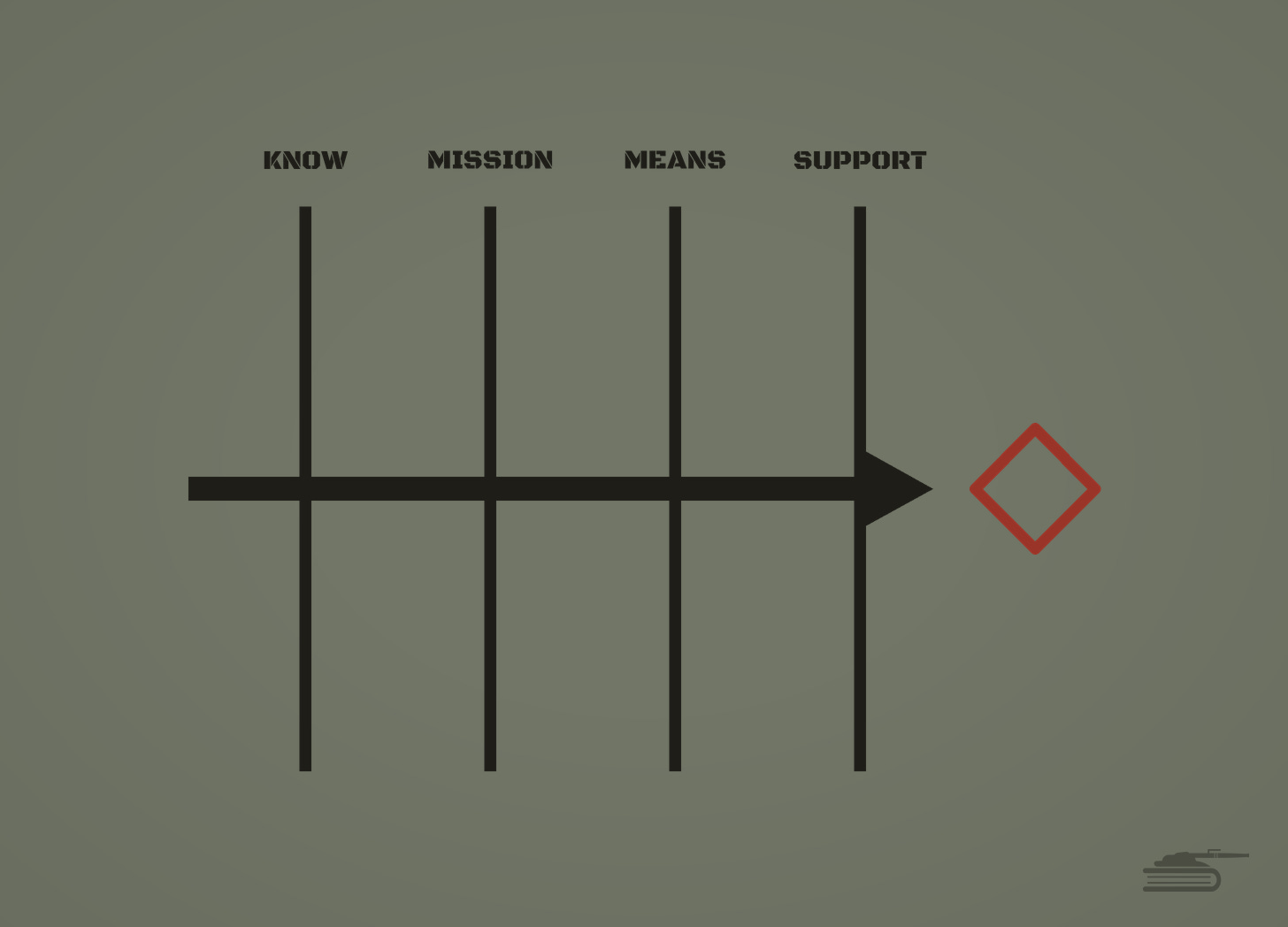
The sequence: know them, give them the mission, give them the means, brief the support. Every line gets crossed before the objective.
BUSINESS
The fundamentals of supporting a team in business are exactly the same. Only the missions, the resources, and the training change.
Know them
The business version of walking the lines is the one-on-one that isn’t a status meeting. Most managers run one-on-ones as project updates; the project update is the part you could get from a dashboard. The part you can’t get anywhere else is what the person is trying to become, what is going on at home that affects the work, and what they would never bring up on their own. The analyst who wants to move into product. The coordinator whose daycare closes at five, which makes your 4:30 standing meeting a daily problem she’ll never mention.
And the same upward job: when the promotion list is being built, the raises are being decided, or the interesting project is being assigned, your people aren’t in the room. You are. Representing them there is the part of care that costs you something, which is why it’s the part they remember.
Give them mission type orders
Task your teams with clear intent, an end state to work toward, and the boundaries that keep them from drifting into another team’s lane — and stop writing the how. The pattern from the field holds: new people and new teams get more detail, and the detail shrinks as they prove they can plan. The test is whether they could make a good decision about the work if you were unreachable for a day.
Give them everything they need to succeed
You cannot expect an under-resourced, under-trained team to succeed, and in business this failure is common and quiet: a team is handed a goal while the people it needs to hit that goal report to someone else. The ideal state is the one the Marine Corps builds by default — the team’s leader has people directly assigned to them with the mix of skills needed to handle whatever the mission throws at them. That is the unity of command argument, and it is a welfare argument as much as an efficiency one: nothing burns a good team out faster than owning an outcome without owning the means.
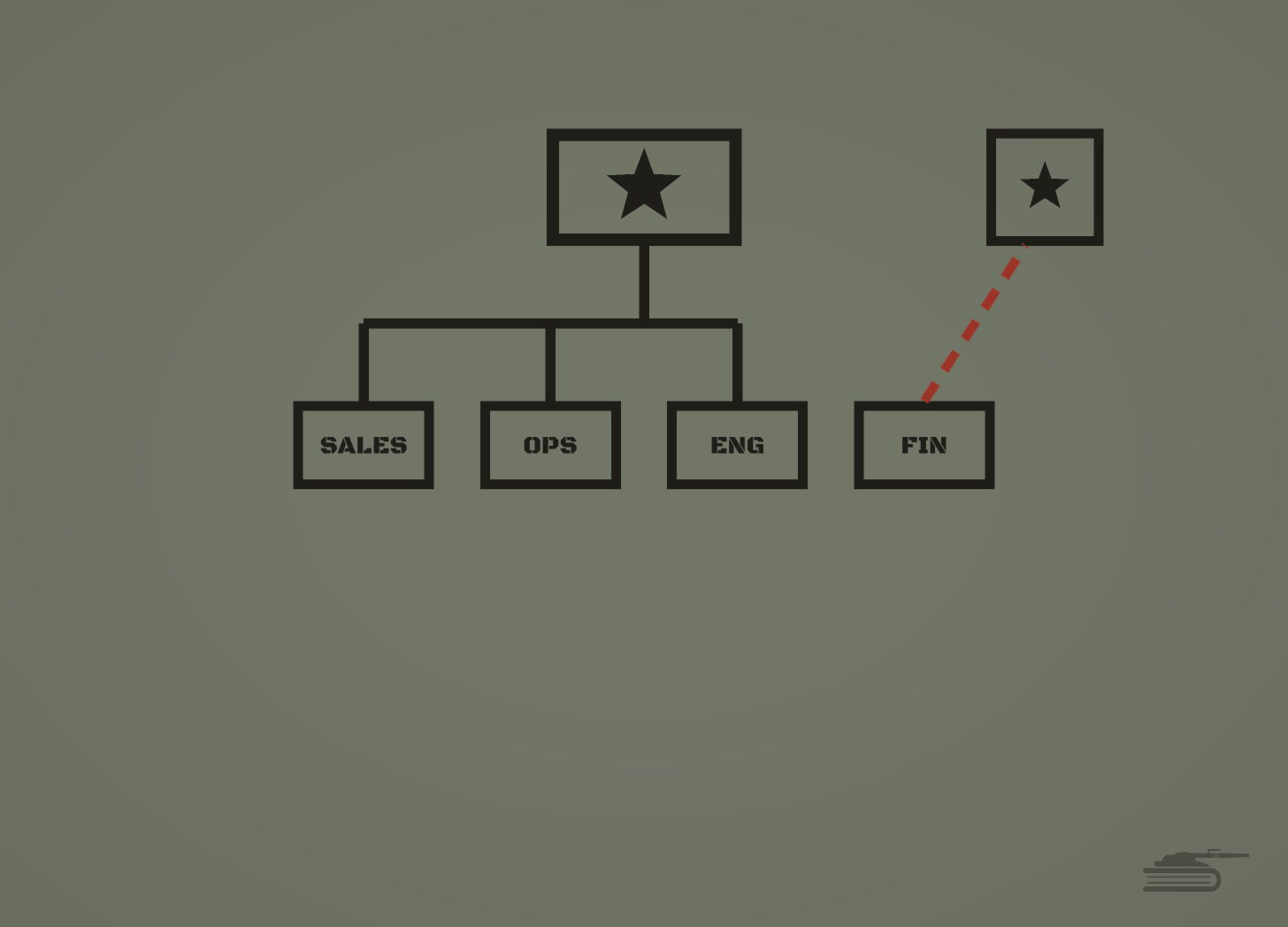
Owning the outcome without owning the means: three of the capabilities the team needs report to its leader. The fourth reports to someone else, and the team pays for it.
Training means the actual skills and tools to do the job in front of them, not a course catalog. If the mission is beyond the level of the team, either change the mission or change the team’s capability before you launch them. Launching anyway and hoping is not a plan; it’s the field exercise where the point element misses the turn.
Bring the supporting arms
A well-run team will still hit problems bigger than it is: a vendor that won’t move, a budget decision stuck two levels up, a customer escalation, another department that won’t deconflict. Calling for fire in business is the leader doing the thing only the leader can do — the phone call to the vendor’s VP, the budget decision made today instead of at the next cycle, the conversation with the peer leader who’s blocking you.
The fire support plan translates directly, and almost no company has one. Before the project starts, tell the team what support exists and what triggers it: if the vendor misses the date, I call their VP. If you need another engineer, here is where one comes from. If the customer escalates, bring it to me the same day. Most teams find out what help was available by failing first — grinding for three weeks on a blocked contract that one call from the CEO would have cleared, because nobody told them the CEO would make the call.
When a team is failing
As a leader, your job is to make your teams successful. Their success is your success. So when one of your teams is failing, assume positive intent and check the four fundamentals, in order, before you reach any conclusion about the people:
Do they actually know the mission — the intent and the end state, not just the task?
Are they resourced and trained for it? Do they own the means to the outcome they own?
Are they hitting problems bigger than they are, and do they know how to call for support? Did I deliver it when they did?
Do I know what is going on with them as people?
Nine times out of ten the answer is in that list, and the fix is yours to make. If you’re confident all four are in place and the team is still failing, then it’s more likely you have the wrong people for the job — and you’ll be making that call with a clear conscience, because you checked.
Key takeaways
Taking care of your people is making them capable of winning, not making them comfortable. Hard training is care.
Know them first. You can’t task, resource, or push a team correctly if you don’t know who’s in it, and they can’t take hardness from a leader they don’t believe is on their side.
Give them the mission, resource them to win it, and brief the support plan before they go, not after they’re stuck.
When a team fails, check the fundamentals before you blame the team. The gap is usually the leader’s to close.
References
United States Marine Corps. MCWP 6-10, Leading Marines. Free PDF
Marine Corps University, Lejeune Leadership Institute. Marine Leaders Notebook (leadership principles and traits). Free PDF