


Unity of command: one commander, with the authority to direct everyone working toward the objective.

Unity of command: one commander, with the authority to direct everyone working toward the objective.
Summary
Assign a single person who is responsible for solving the problem.
For cross-functional work, set up a project team with a single leader and every capability needed to solve the problem.
WAR
Unity of command is one of the nine principles of war. It is the principle that overall responsibility should be assigned to a single person. That gives them the authority to sequence and allocate everyone on the team so it is as effective as possible at achieving the goal.
The US Marine Corps defines unity of command in MCWP 3-10, MAGTF Ground Operations, as:
Unity of command means that all forces operate under a single commander with the requisite authority to direct all forces employed in pursuit of a common purpose… Unity of effort, the coordination and cooperation toward common objectives, even if the participants are not necessarily part of the same command or organization, is the product of successful unified action. Commander’s intent, what must happen and a description of the end state, is the foundation for both unity of command and unity of effort.
The need for a single commander was learned repeatedly in combat. Operations failed because no one had the authority to put all the pieces together and get the most out of the team.
Allocation of scarce resources
It is very hard to get complex teams to work together without a single designated leader. Even with selfless and competent leaders, there will always be disagreements about priorities, because some teams will inevitably have to sacrifice more than others.
Every leader wants their team to succeed, and to succeed they want as many resources as possible. Resources are always limited. Deciding which team gets them is where the sacrifices begin.
That prioritization has to be a single leader’s decision.
Sequencing of teams
Sequencing is another decision that belongs to a single leader. The timing of when each team executes its work is important and delicate.
Perfect execution would be a perfectly orchestrated sequence: each team hits its timeline exactly, which lets the next team start its share of the work.
Perfect sequencing never happens in real life, so every team is sequencing as well as it can. Bad sequencing generally happens because no one is holding anyone back. If every team pushes full bore toward the goal, a bottleneck develops, and one team ends up blocking everyone else.
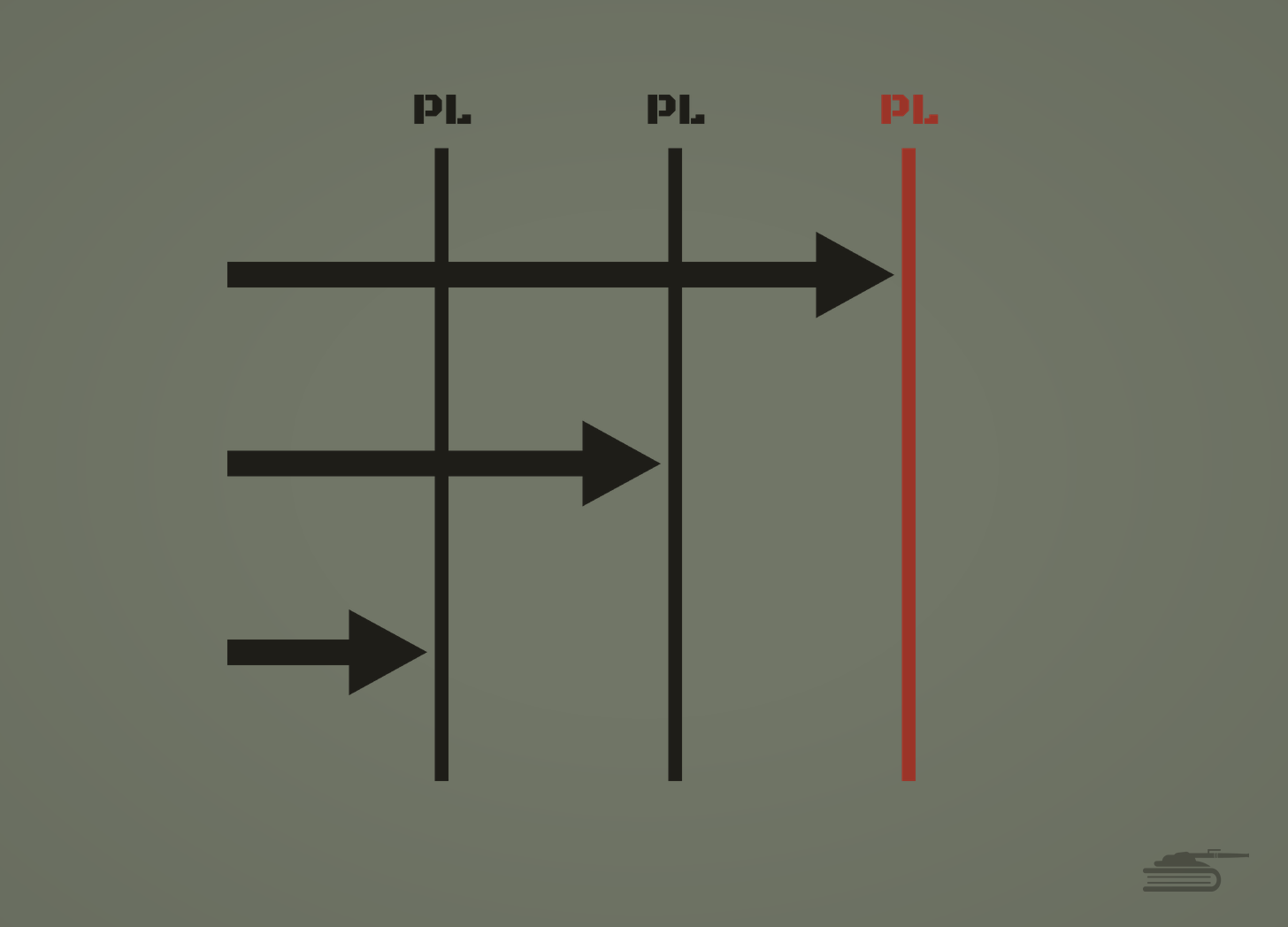
Three teams on one timeline. The lead team has reached the red phase line and has to wait. Without one leader holding the others back, this is where the bottleneck forms.
A single leader has the responsibility to hold teams back and sequence them as close to perfectly as possible.
Decision-making with or without unity of command
The decisions needed to prioritize and sequence resources are best made by a single responsible person.
Without one, those decisions have to be made by mutual agreement, which is sometimes impossible and always slow. Reaching consensus on every decision as a leadership team takes considerable time and effort.
It is much more efficient to have a single leader who can take in all the inputs and drive the decisions.
Example
Imagine you are a Marine sergeant leading a squad of 12 Marines. You are tasked with setting up a small forward operating base alongside another squad, also led by a sergeant. While building the base’s security plan, the two of you disagree about how to position the machine guns. You are the same rank, and neither of you was assigned as the leader for this task. Friction follows, decision-making slows, and a power struggle sets in.
That is a lack of unity of command.
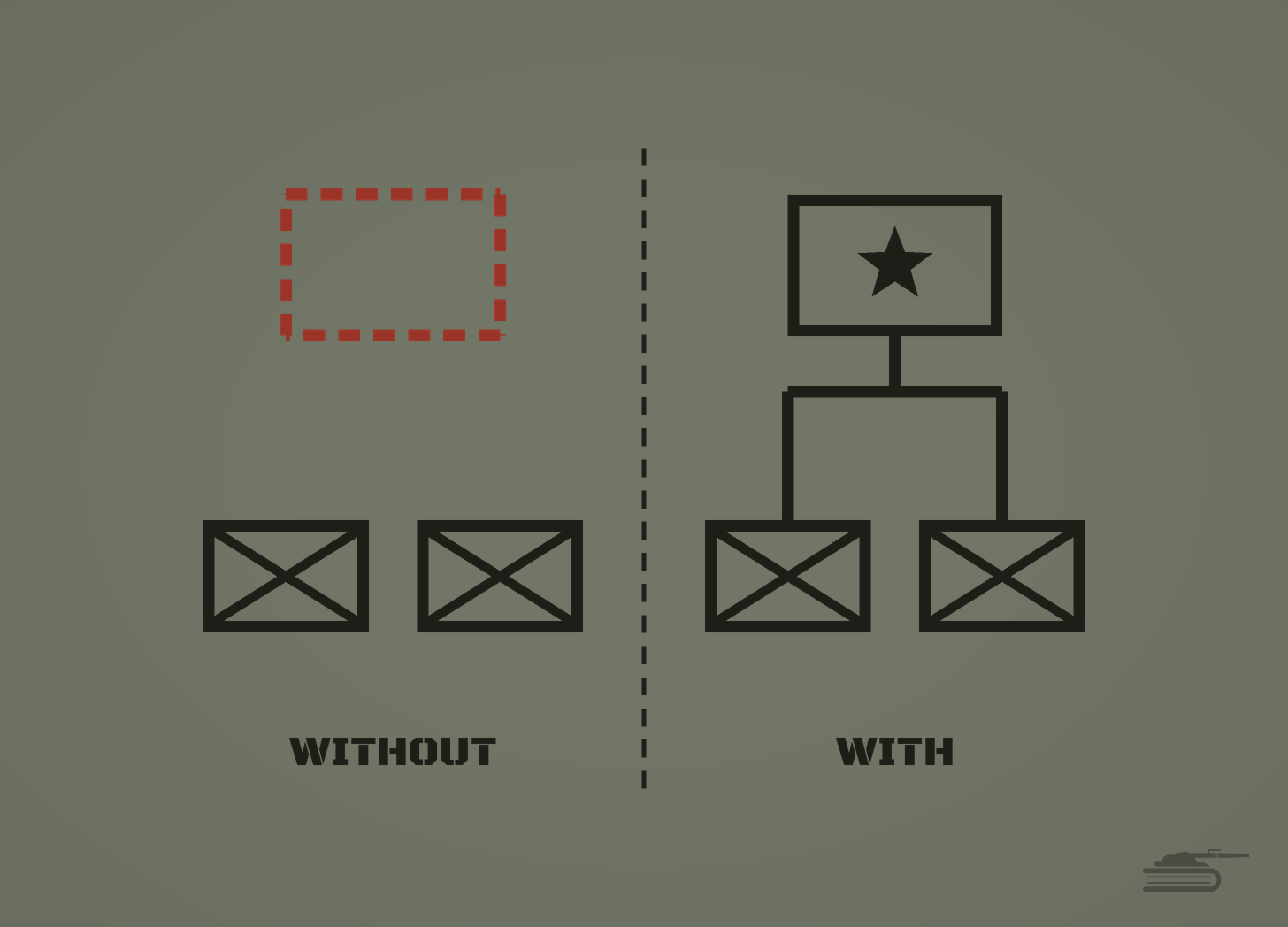
Left: two equal squads and no one above them. The red frame is the gap where a commander should be. Right: unity of command.
When no one responsible is assigned to a task, it either doesn’t get done or doesn’t get done well.
This applies at every level, from a small task to a large operation. Size doesn’t matter. What matters is that one person is put in charge, all decisions and responsibility stop with them, and the entire team understands their authority.
BUSINESS
Unity of command translates cleanly to the civilian world.
When you assign a task or a project, make it clear that there is one responsible person, and make that person as close to the problem as possible.
In business this is harder than it sounds. A project involves many teams, most of them in different departments, and the first person with authority over all of them is often a vice president or higher.
That is a problem. Vice presidents are generally pure leaders; they will not be closely involved in a cross-functional task or project.
In that situation, the Marine Corps would put people in direct support of the effort and still assign one leader, usually the ground commander closest to the fight.
In the civilian world, that should be the leader closest to the problem, and they should be given a cross-functional team so they can succeed.
This is what that looks like:
Your priority projects have a dedicated team with every key department represented (procurement, finance, marketing, operations, engineering, and so on).
All of those people report to one leader, who is given decision-making authority.
The project is their highest priority. All other work stops.
Team members are not tasked with anything that affects their project work. If they have spare capacity, they can ask their department lead for more, with the project lead’s agreement.
Work is prioritized through the project leader. Department leaders provide assistance and expert advice.
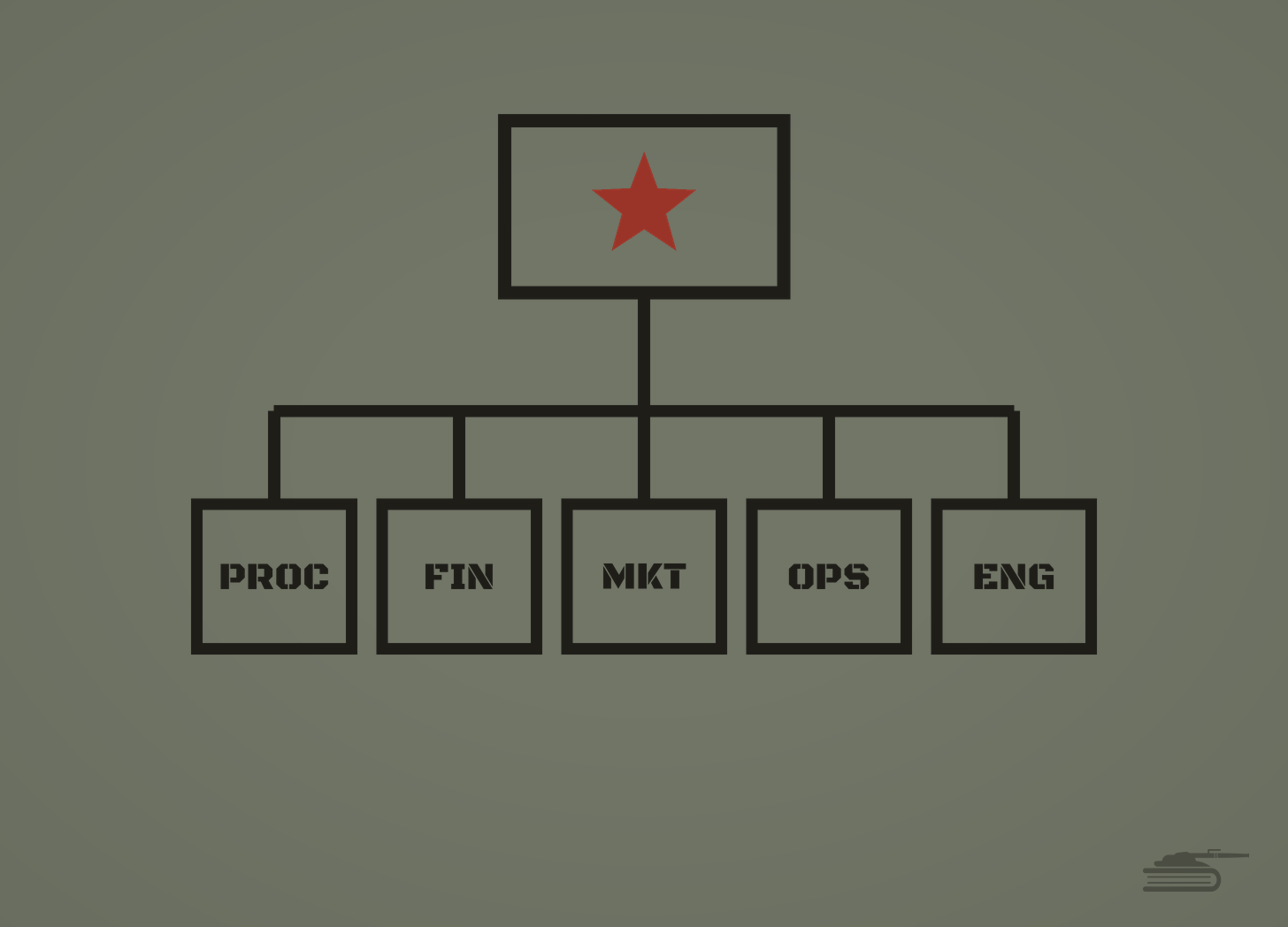
One project lead with decision-making authority over a dedicated cross-functional team. Department leads advise; the project lead prioritizes.
The only argument against this setup is “we don’t have enough people to dedicate to projects.” That means you are doing too many projects. Focus on the most important ones with the people you have.
The ideal state: your highest-priority project has a dedicated team with every kind of expertise it needs, working together and reporting to a single leader who is responsible for its success. That leader may not be from their department. A marketing person can take priorities from an operations person, if that is the right leader.
This is very similar to how Scrum works in software development.
Key takeaways
Assign one leader to fix the problem and give them a team with all the knowledge and capabilities needed to succeed.
The entire team should know that person is their leader and that all responsibility stops with them.
References
Headquarters United States Marine Corps. 2018, April. MCWP 3-10 MAGTF Ground Operations. Link