


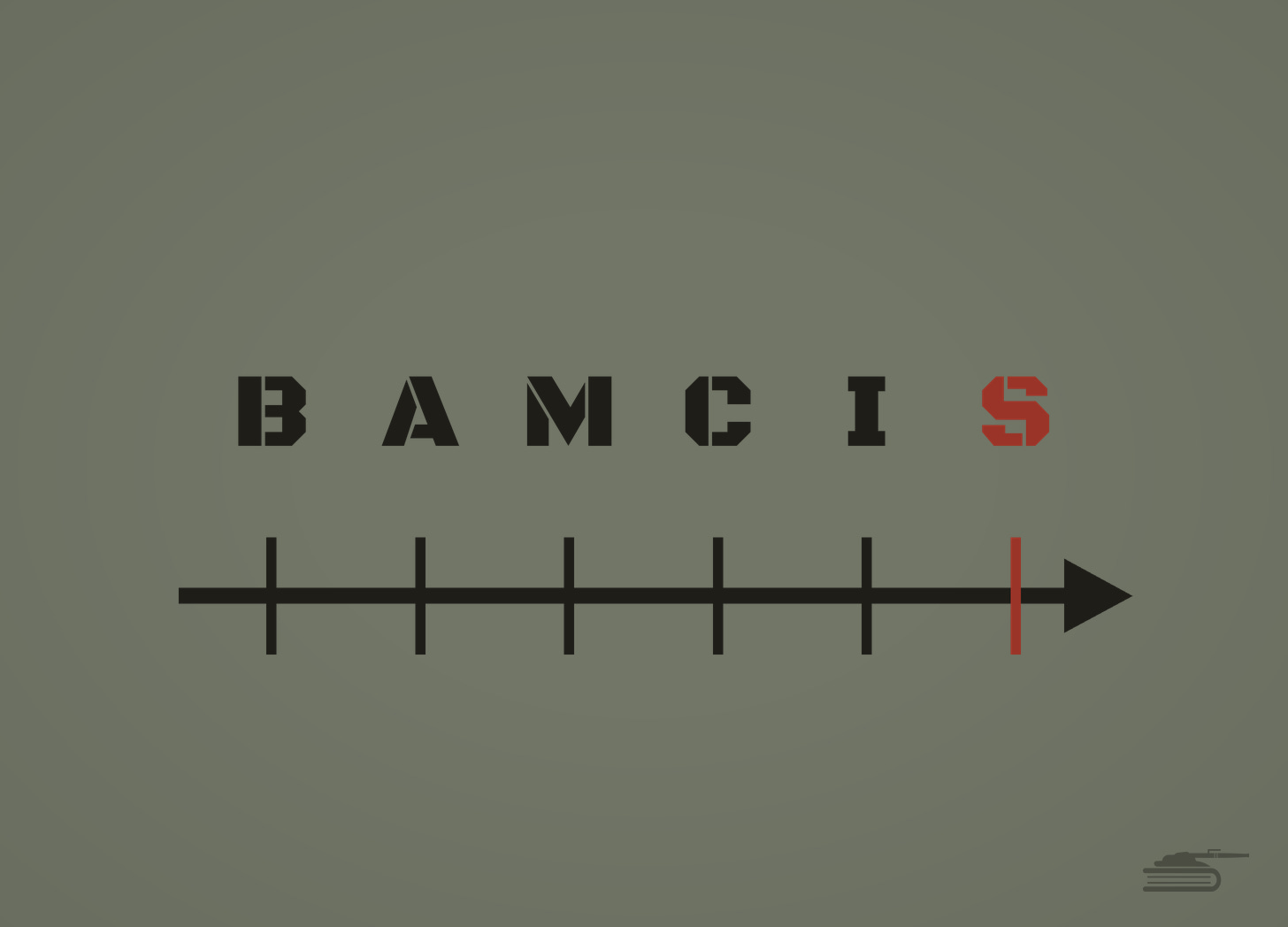
BAMCIS: six troop-leading steps on one axis. Ask any Marine which one matters most, and they’ll yell the answer.
Summary
Every Marine leader is taught one basic planning process, so that planning becomes reflex under pressure.
The heart of it is reconnaissance: identify the assumptions your plan depends on, then go confirm them before you commit.
For business, three steps: analyze the problem and develop options; get answers to the questions that decide between them; decide, execute, and supervise.
WAR
Planning and preparation are huge drivers of success. The military figured that out a long time ago and built standard planning processes to train Marines to plan their operations deliberately. This article covers the most basic one: BAMCIS.
Like most things in the military, BAMCIS is an acronym:
B — Begin planning
A — Arrange reconnaissance
M — Make reconnaissance
C — Complete the plan
I — Issue the order
S — Supervise
It’s taught to young officers and non-commissioned officers as the way to turn a mission into an executable plan, and it is drilled until they think in it naturally in combat. The more repetitions a leader has with the process, the better their decision-making gets.
Here is each step, with what it means for a business leader.
Begin planning
Begin planning is the initial evaluation of the information your commander gave you. Under ideal conditions that arrives as a five-paragraph order or a fragmentary order (frag-o): the friendly and enemy units in the area, your mission, the plan of attack, coordinating instructions, and the supporting assets at your disposal.
The Marine runs that information through an analysis called METT-TC — mission, enemy, terrain and weather, troops and fire support available, time available, and civil considerations — which feeds their own five-paragraph order. (METT-TC and the five-paragraph order each deserve their own article.)
The outcome of Begin planning is a detailed analysis of everything your commander gave you and an initial plan to accomplish the mission.
Part of that initial plan is identifying your risks and assumptions — the gaps in your information that, if filled, would most increase your chance of success. Deciding how to confirm those assumptions is what drives the next step.
Business takeaways
When you’re handed a problem to solve, an opportunity to capture, or a project to lead, spend real time on the initial planning.
The main output of that planning is a list: what information do you need to make the best possible decision? Which part of the task do you understand least? What data exists? Who has worked on this before? Who else needs to weigh in?
That list drives your information-gathering phase, which is the next step.
Arrange reconnaissance and make reconnaissance
The next two letters, A and M, stand for arrange reconnaissance and make reconnaissance. They are separate steps in execution; I’ll cover them together.
Your initial plan carries risks, and most of them trace back to unconfirmed assumptions: about the route, the enemy, the vehicles, the communications. You prioritize those assumptions and arrange reconnaissance against them — specifically the assumptions that, if wrong, would do the most damage to the mission.
The Marine confirms them by any available means: a drone, snipers sent forward, someone who has walked the route before. The most common method is the leader’s recon, because it is always available. You may have no other reconnaissance assets, but you can always go look yourself.
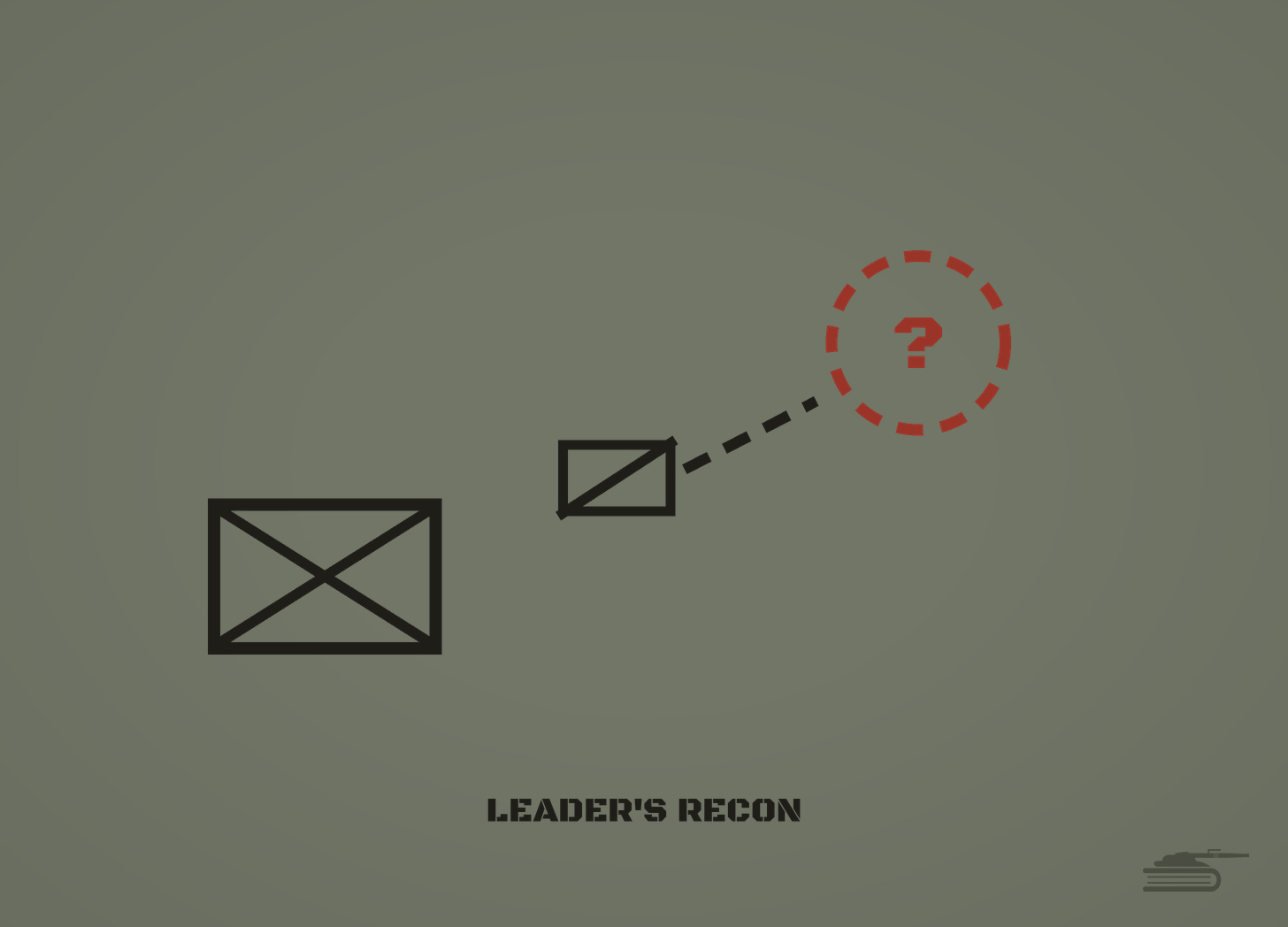
The leader’s recon: a small element goes forward from the unit to confirm the one thing the plan can’t survive being wrong about.
To arrange it, you prioritize what must be confirmed and assign someone — often yourself — to go confirm it. That means leaving a large portion of the platoon or company behind, and it is a risky move: the recon element can get killed or lost, and the Marines left behind can get attacked. The Marine Corps has learned the hard way that it is riskier still to go into combat with too many assumptions in the plan. The recon is worth it.
It’s telling that the Corps split arranging from making. The point of arrange reconnaissance is to force you to think through all of your assumptions and get creative about confirming them. If the process had simply said make reconnaissance, the thinking about how to do it well would have been skipped — and the step would have been treated as a formality.
When the leader returns from reconnaissance, the assumptions are confirmed or disproven, and the plan can be finished.
Business takeaways
In the previous step you listed the information you need. Now prioritize it by impact and by when it’s needed — the sales data, the financial analysis, the conversation with the engineering stakeholders. Whatever most improves the decision gets gathered first.
Make a plan to go get it. Delegate within your team or do it yourself, and task whoever goes with exactly what information you need and why.
That will mean finding the data, setting up stakeholder meetings, reviewing history, and looking at competitors and the market.
Complete the plan
After reconnaissance, the assumptions have been confirmed or proven false, and the leader can make final decisions and accept the remaining risk knowing the preparation has been done. This is the chance to modify the plan — or change it completely — based on what the recon found.
The hill you wanted for a machine-gun position turns out to be a cliff, so the position moves. The river has only one crossing, miles out of the way, so the route changes. The enemy force is twice the size intelligence predicted. Whatever is learned gets incorporated.
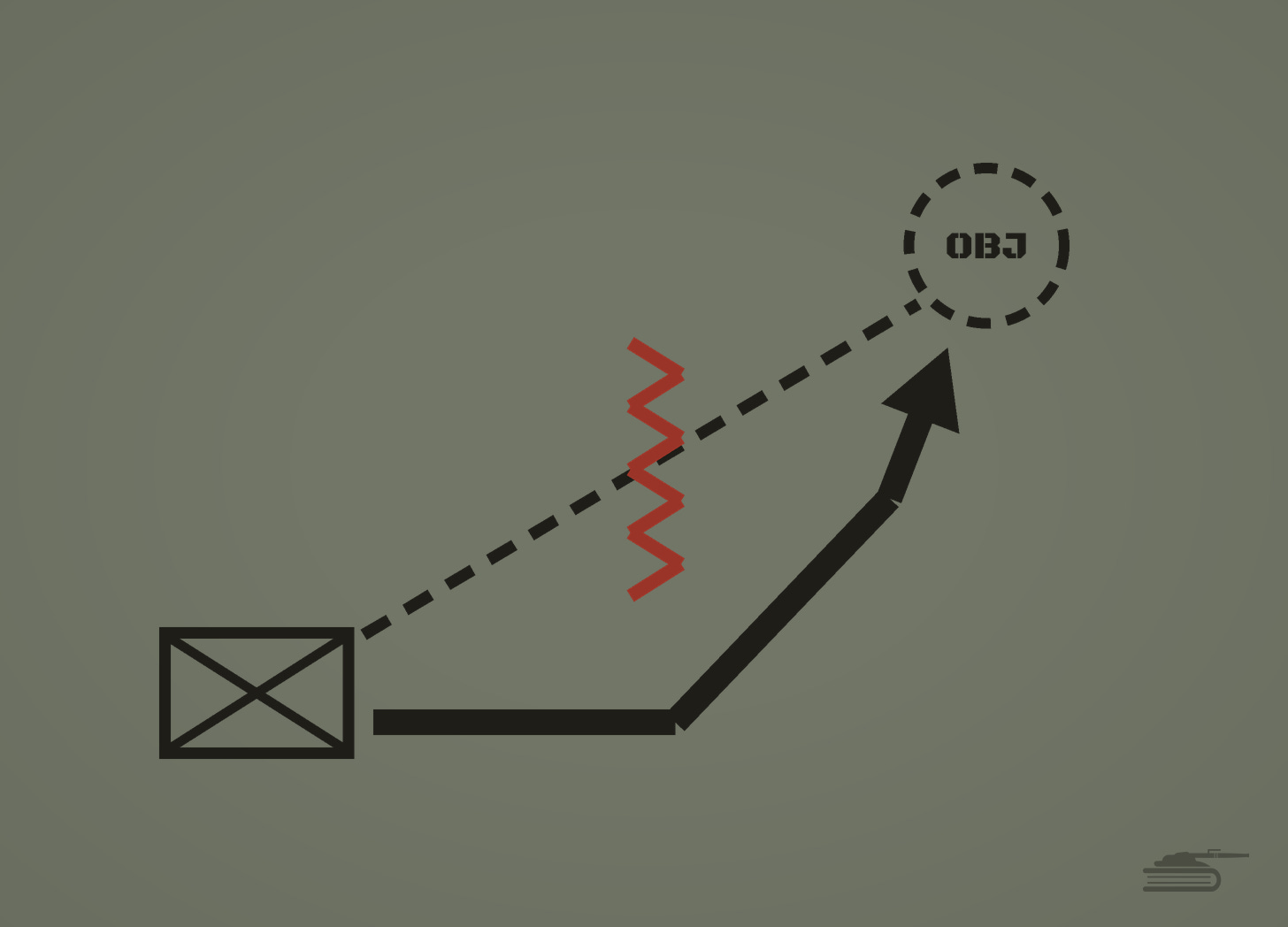
Complete the plan: the planned route (dashed) ran straight into what the recon found. The completed plan goes around it.
This is the Marine Corps being adaptive and refusing to fall in love with its plans. A lot of blood was spilled learning that lesson. Rigid plans built on too many assumptions lose.
Business takeaways
As your questions get answered, update the plan and refine the decision. Keep one living document everyone works from, so the plan the team sees is always the current one.
Issue the order
Now the Marines get the order. The intent is for the team to know the plan as thoroughly as possible. The Corps does this in the five-paragraph format, which conveys the information in a familiar flow and ensures nothing key is left out: if the leader hits every paragraph and subparagraph, everything necessary has been passed. Then it’s time to execute.
Business takeaways
The business equivalent is the kickoff meeting. Everyone leaves aligned on the plan and clear on their piece of it — and clear on the intent and end state behind it, so they can decide without you when things change.
Supervise
When I was learning BAMCIS, the instructors would ask, “What’s the most important step?” and the whole class would yell, “SUPERVISE!” (Marines like to yell.)
The last step is making sure the work in the plan actually gets done. The first thing to supervise is understanding: have your key leaders back brief you on the overall plan and their responsibilities inside it. That usually looks like them giving you almost the exact brief you just gave them, with you correcting mistakes until every one of them can brief the whole plan clean. Then they do the same with their teams, until the plan is known inside and out at every level. The Marine Corps has a formal version of this called a ROC walk, which is a post of its own.
When execution starts, the leader sets the example, places themselves at the friction points between units, and keeps everyone working as one team toward the mission. It takes many forms, but it usually means being with your team while they work.
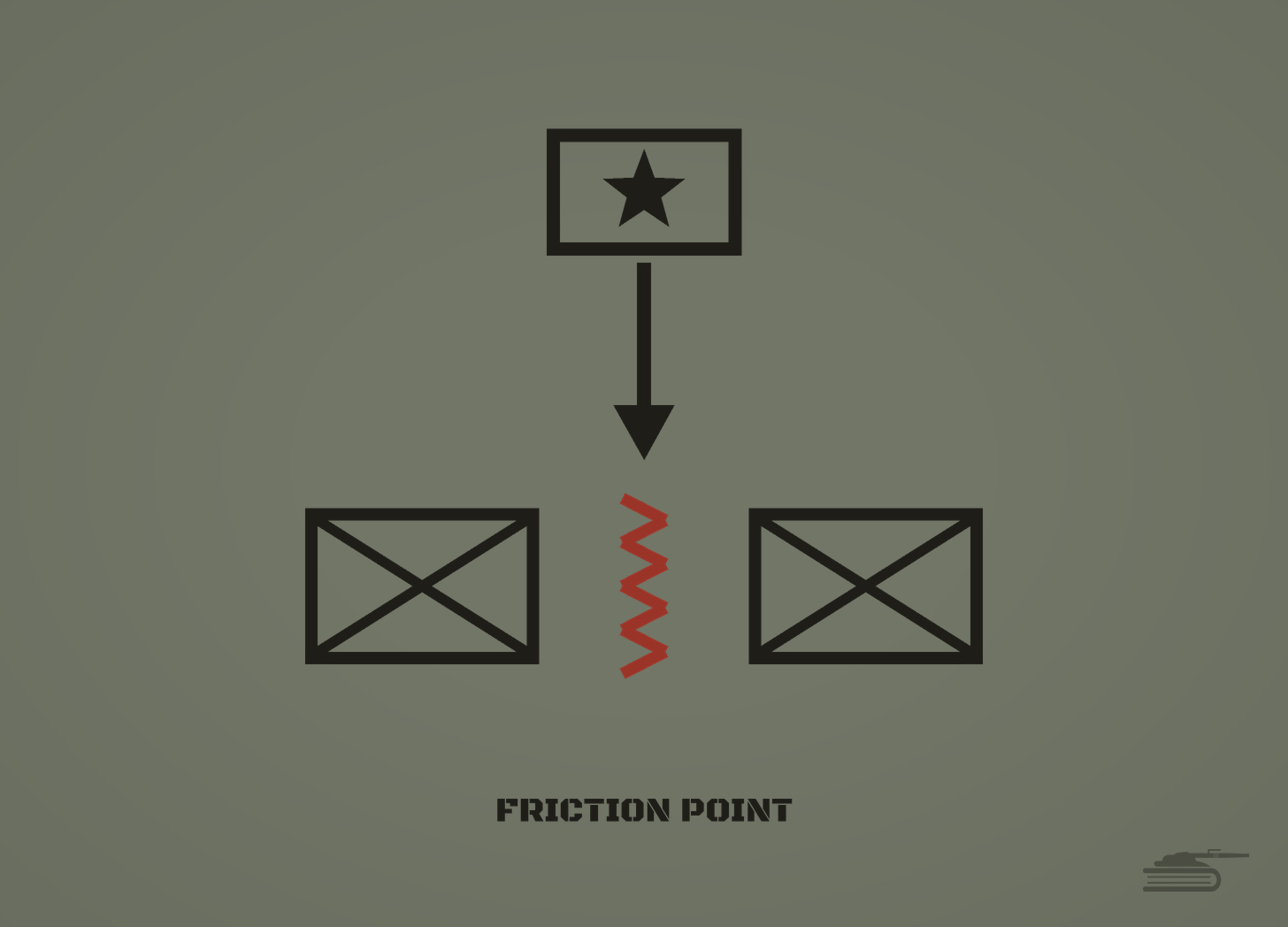
Supervise: the leader’s place during execution is the friction point between teams, where decisions are needed and sequencing breaks.
Often all the work has been delegated and the leader has little direct work left in execution. The work that remains is the leader’s alone: be present to deconflict the teams, make timely decisions, and accept work as complete so the team can keep moving.
That is how the Marine Corps uses one simple planning process to help every leader build a plan that wins.
Business takeaways
Supervising is the most important step of the planning process.
Check in with your team and show them you’re working alongside them.
Deconflict teams, make decisions, and accept work quickly, so nobody is waiting on you.
BUSINESS
Every organization would be better off with a basic planning process that can be taught to its leaders and followed by them — paired with a communication format, which is a separate topic. A shared process trains leaders to consider everything that needs considering, and it stops the pattern most companies run on: decisions made without a clear mission, without confirming assumptions, and without honestly analyzing logistics and time.
Here is the version I recommend. It is BAMCIS with the field stripped out: three steps.
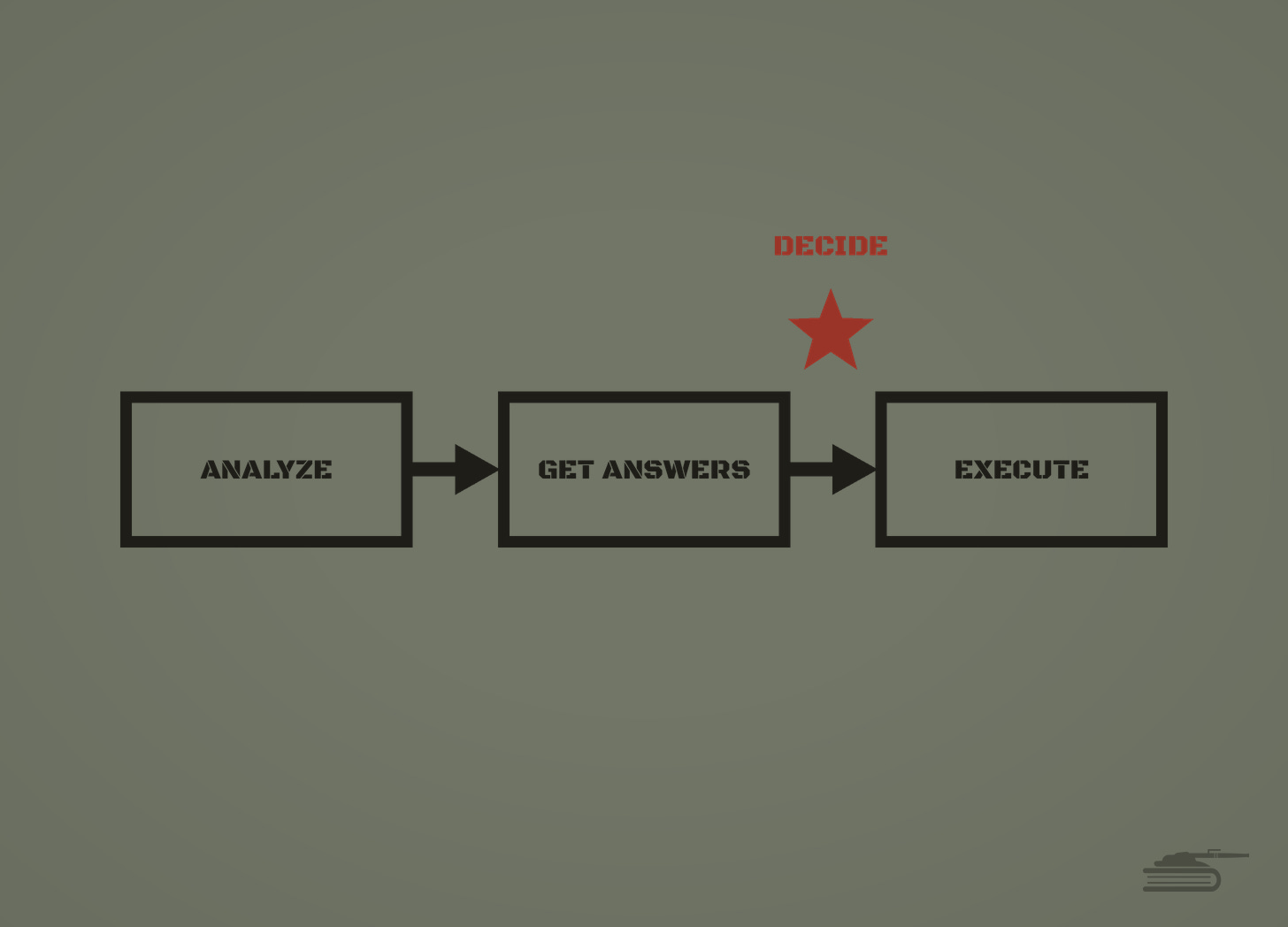
The business planning process: analyze the problem, get answers to the questions that matter, then decide and execute.
Step 1: Analyze the problem and develop options
The analysis has three parts: a problem statement, the options, and the questions.
The problem statement is one simplified sentence. “Increase sales in Michigan.” “My team isn’t getting enough exposure, and it’s limiting their promotability.” The point is a problem everyone can understand the same way.
The options are the different ways to solve it. Everything has tradeoffs; you’re looking for the decision with the best terms for your goals. Brainstorm with as many stakeholders as you can, and come out with two to four candidate solutions.
The questions are a parking lot for everything that came up while building the first two parts — prioritized by impact on the decision. The better you understand the options, the more obvious the most important questions become.
Sometimes the right answer is already clear by the end of this step. If so, skip ahead and execute. If not, the questions drive the next step.
Step 2: Get answers to the most important questions
You now have a prioritized list of questions which, if answered, would let you make the best decision available. Get as many answered as time permits. Some take a quick meeting or an email; some take several meetings and real analysis; some you won’t be able to answer at all.
The focus is the exact information needed to make the decision — not a mountain of data. Usually one or two critical pieces point to the solution, and that’s where the effort goes. Once the most important assumptions are validated, you’re ready to decide.
Step 3: Choose the best option and execute
Finalize the path forward by stating each team’s tasks clearly, then confirming they understood — by having them repeat the tasks back, or by having them build their own plan consistent with yours. Confirming understanding from every team member is not optional; it’s the step that saves you in execution. (If you read the Connecting File post, this is the read-back.)
Then execute. Execution is the hardest part, and the leader’s job during it comes down to two things:
Make decisions. It’s easy to tell two peer teams to work it out themselves — and expensive, because now they spend days negotiating a decision you could have made in a minute. Be there to make it and keep everyone moving.
Deconflict and sequence your teams. The most common failure when leadership is absent is teams not working together — one starting too early, another too late. That is always a communication failure by the leader, whose job is to sequence the teams. Nothing wastes more resources than bad sequencing. (This is unity of command doing its job.)
There’s a wide spectrum between micromanaging and being hands-off. At certain points in a project the team needs you and will be grateful you’re there; at others your presence only creates work. Find the places you add value: the friction points between teams, and the moments your team needs a decision to keep moving.
Conclusion
A leader is either taking action or preparing to take action, and part of preparing is a solid plan — executable, and built on as many facts as possible. A planning process is how you teach leaders to produce one.
In the Marine Corps, that process is Begin planning, Arrange reconnaissance, Make reconnaissance, Complete the plan, Issue the order, and Supervise. In your organization it can be anything that fits your work. My recommendation:
Analyze the problem and develop options to solve it.
Get answers to the most important questions.
Decide, execute, and supervise.
The biggest lesson: whatever your process is, teach it to the leaders below you. The better the decisions across your organization, the more successful it will be.
Key takeaways
Marines are taught one planning process until it becomes reflex under pressure. Give your leaders one too.
Most plans fail on unconfirmed assumptions. Name them, prioritize them, and go confirm the ones that would hurt most.
Supervise is the most important step: confirm understanding before execution, then stand at the friction points during it.
References
United States Marine Corps, The Basic School. “Tactical Planning Process I” (student handout B2B0255XQ). Link
United States Marine Corps. MCRP 3-10A.4, Marine Rifle Squad. Link