



This is the first post in a series on discipline — the Fieldcraft side of War and Business, where the subject drops from the team to the individual. I’m going to write a lot about discipline, because it’s the most important driver of success that almost nobody can define.
Other than talent, I believe discipline is the biggest driver of success for any person or team. If you don’t believe that, it’s probably because you don’t share my definition of discipline.
The word is confusing. Ask most people to define it and they won’t have much of an answer, let alone an accurate one. Even the big voices who preach discipline — Joe Rogan, Jocko Willink, David Goggins — mostly land on some version of “doing what you’re supposed to do even when you don’t feel like it.” (Here is an entire video of Jocko Willink talking about discipline as generally improving yourself, without ever actually defining it.) Doing hard things when you don’t want to is part of discipline. It is not a definition of it.
If you’re a normal person trying to become more disciplined, and your only definition is “do things when you don’t feel like doing them,” you have nothing to grab hold of. The way forward stays confusing — mostly because we don’t actually know what we’re trying to build.
So: discipline is one of the most important drivers of success for any person or team, and as a society we barely know what it is. That’s a crazy situation to be in.
I’m going to set in my defensive position and die on this hill. My definition of discipline:
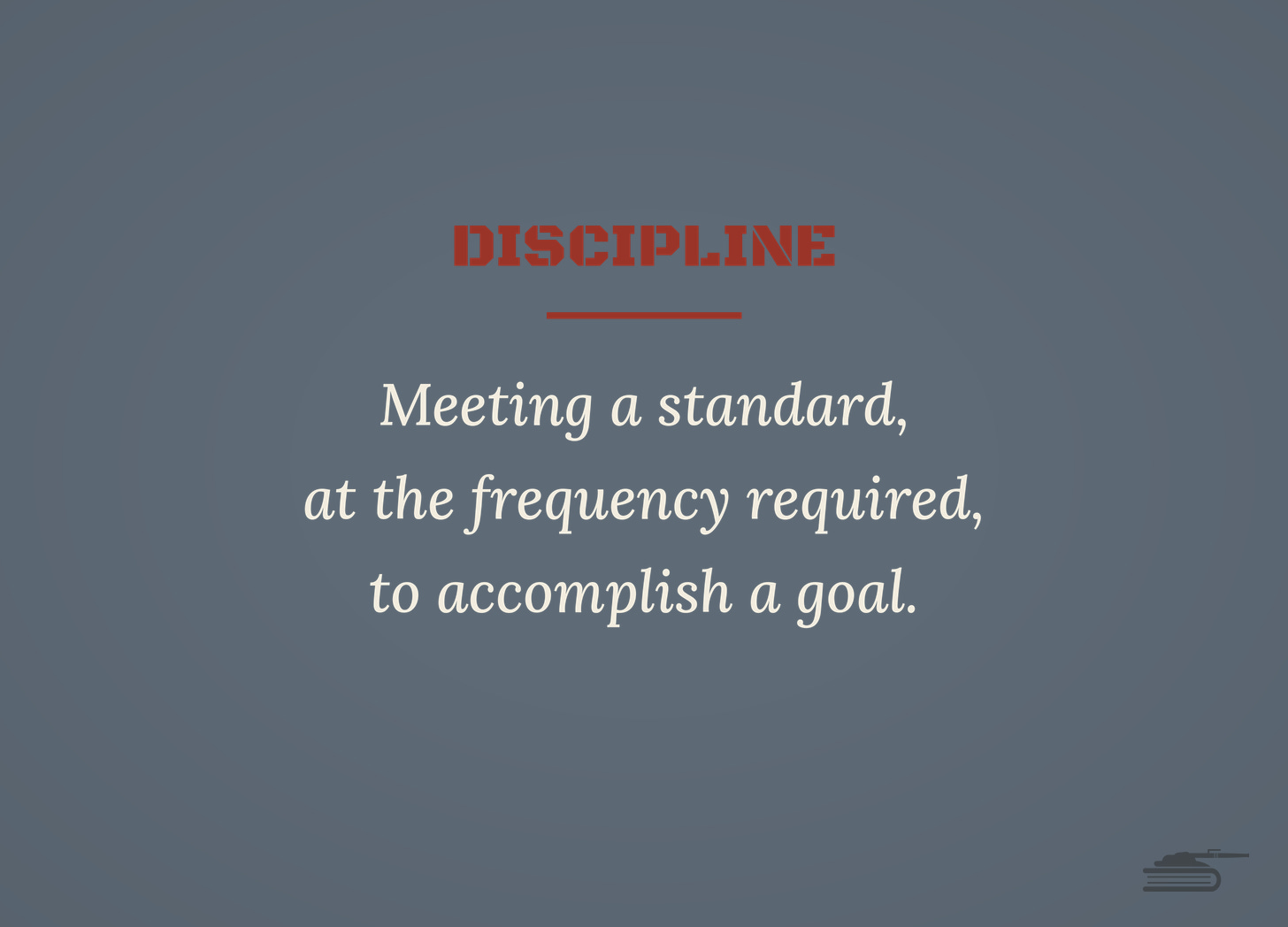
Discipline is meeting a standard, at the frequency required, to accomplish a goal.
That’s it. Three parts. A standard — the thing you do, and how well you do it. A frequency — how often you meet it. A goal — what meeting it is for. It works the same for a team or an individual: meet the standard, at the frequency, and the goal arrives.
How I landed on this definition
I’ve been trying to figure out what discipline is for years. I’m in the Marine Corps, and most people would agree the Marine Corps is the most disciplined branch of the military. So the obvious question I asked myself: what makes the Marine Corps more disciplined than every other branch?
I interact with the Navy the most, and when I thought about the difference, it came down to this: the Marine Corps has higher standards. And the organization — mostly its leaders — holds itself and everyone in it accountable to those standards. If you don’t meet them, the Marine Corps will, with absolutely no empathy at all, remove you, because you are not meeting the required standard.
What I landed on: the difference between discipline in the Marine Corps and the other branches is meeting a higher standard, frequently enough to accomplish the organization’s goals.
Once I had that framework, I started thinking about the people in my life who were more disciplined than me — in school, in sports, at work. In every case, they had higher standards, and they met those standards more often than I did.
Examples of discipline
Being a disciplined student means holding high standards and meeting them for the entire semester. You organize your coursework, do all the reading, finish every assignment, start and finish your essays well in advance. Those are high standards, and meeting them all semester long is the frequency. Do both, and the goal — good grades — takes care of itself.
I was not that student. I held myself to low standards: unorganized, nothing finished early. So I met a very strict standard in short bursts — cramming — to get passing results. Not only was my standard low most of the time, but I met the strict one with no consistency at all, so I got average results. If you’ve seen the discipline matrix in my Team Discipline post, that’s the top-left quadrant: a high standard met with no frequency. It works well enough to survive and never well enough to excel.
Being disciplined about exercise means meeting a standard at a frequency that accomplishes your fitness goal. Say you want to run a marathon. That means you’re going to run a certain number of times per week — call it four. Running is the standard; four times a week is the frequency. As you get stronger, the standard rises: farther, faster, more often. The best marathon runners in the world run over 100 miles a week, at a pace a normal runner couldn’t hold for a quarter mile. Extremely high standards, met week after week for years, plus talent — that’s how they became who they are.
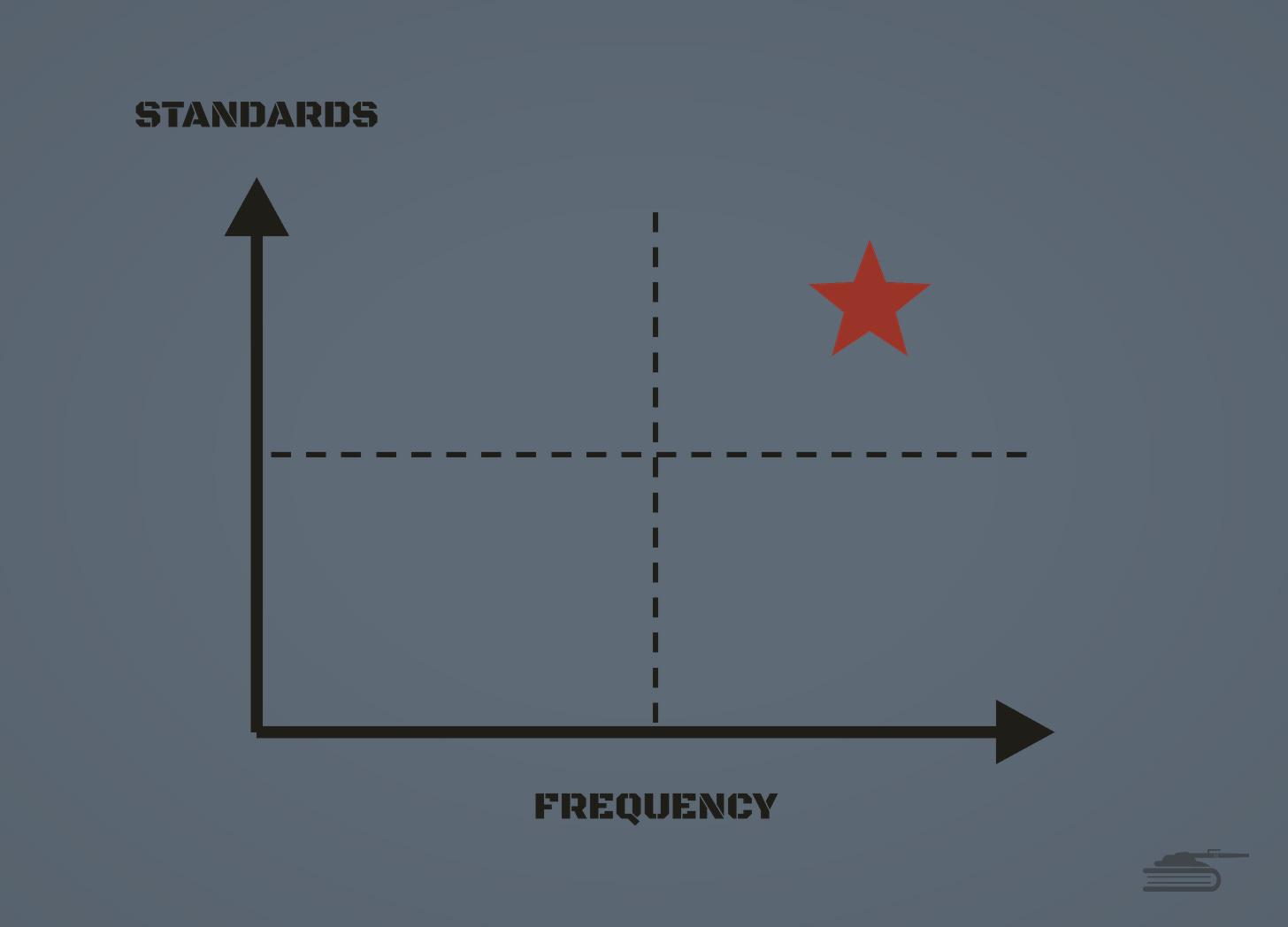
The equation of discipline: standards on one axis, frequency on the other, and the star is the goal met. Cramming lives in the top-left — high standard, low frequency.
We could go on. In almost every case, the people who are more successful at a specific goal have met a higher standard, more frequently, for longer than you have.
That is what discipline is.