


Discipline is the whole formation holding the line. The red unit is where it starts to break.

Discipline is the whole formation holding the line. The red unit is where it starts to break.
Summary
Discipline is meeting a standard, at the frequency required, to accomplish a goal — the standard, the frequency, and the goal it serves.
Set standards the team believes in, and communicate the expectation so no one can say they didn’t know.
Drive consistency with supervision and visible tracking. Praise publicly; support privately.
WAR
Imagine that you are a Marine infantryman. It’s over 100 degrees in the middle of an Afghan summer. You’ve spent the last two days searching dozens of compounds in Taliban-controlled territory. The 60 pounds of weight on your back is crushing your shoulders. You’ve barely slept, and you are dehydrated and hungry.
To search a compound, you take a long stick with a hook on the end and scrape the ground around the entrance to confirm there is no improvised explosive device hidden under the dirt. The next compound you’re tasked with clearing looks like a family lives there. It doesn’t seem threatening. Your exhausted mind justifies not scraping the entryway. Instead, you do a quick scan with your eyes for any disturbance in the ground. You don’t see anything. You take a step over the threshold.
You wake up in a hospital in Germany seven days later with both of your legs missing.
In combat, the smallest things make a huge difference. Did you coordinate the plan? Clean your rifle? Double-check your gear? Scrape every single doorway for booby traps? Everything adds to your chance to win and survive. Discipline wards off complacency by keeping you prepared.
Whoever has the most discipline slowly gains an edge on their enemy. An organization can have better weapons and more technology, but the true difference-maker is an unbreakable will to fight and the discipline to execute every day.
The mentality of discipline
Male Marines are expected to shave every day. Shaving has almost no tactical value. The only reason for it is that it gives your gas mask a tighter seal — and the vast majority of the time, we operate without gas masks, so even that rationale rarely applies.
So why do we force ourselves through the highly inconvenient task of shaving when we’re in the field, it’s 20 degrees outside, and there is no warm water?
The reason is discipline.
Shaving every day is the Marine Corps standard, and we don’t drop our standards no matter the circumstance. When a team stops shaving, next they’ll stop cleaning their weapons, then they’ll stop prepping their gear, then they’ll stop checking every entryway for improvised explosive devices.
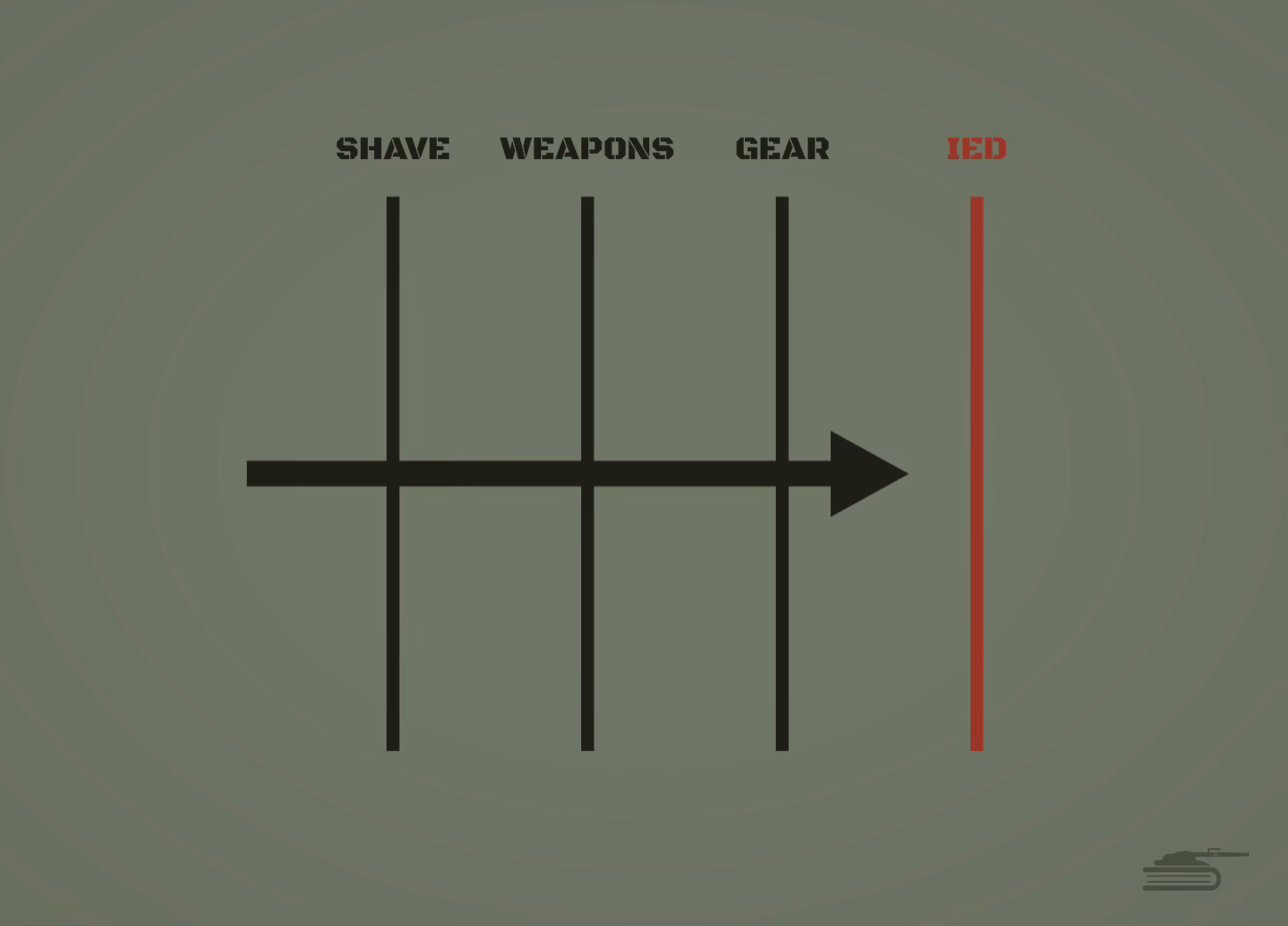
Standards fall in sequence. Nobody skips straight to the one that kills you — they slide there, one dropped standard at a time.
If a person or a team holds themselves to high standards in one area, it’s much more likely they’ll hold high standards in other areas as well.
The mentality of discipline transcends all things.
What is discipline?
I define discipline as meeting a standard, at the frequency required, to accomplish a goal. That gives the equation three parts: the standard, the frequency, and the goal.
The more consistent you are, the more disciplined you are. The higher your standards, the more disciplined you are. If you’re very consistent and hold high standards, you are extremely disciplined.
You can be very consistent but barely meet the standard — just disciplined enough. You can also lack consistency but exceed the standard through intermittent bursts of extreme effort — you’d likely meet the standard, but you would not be very disciplined.
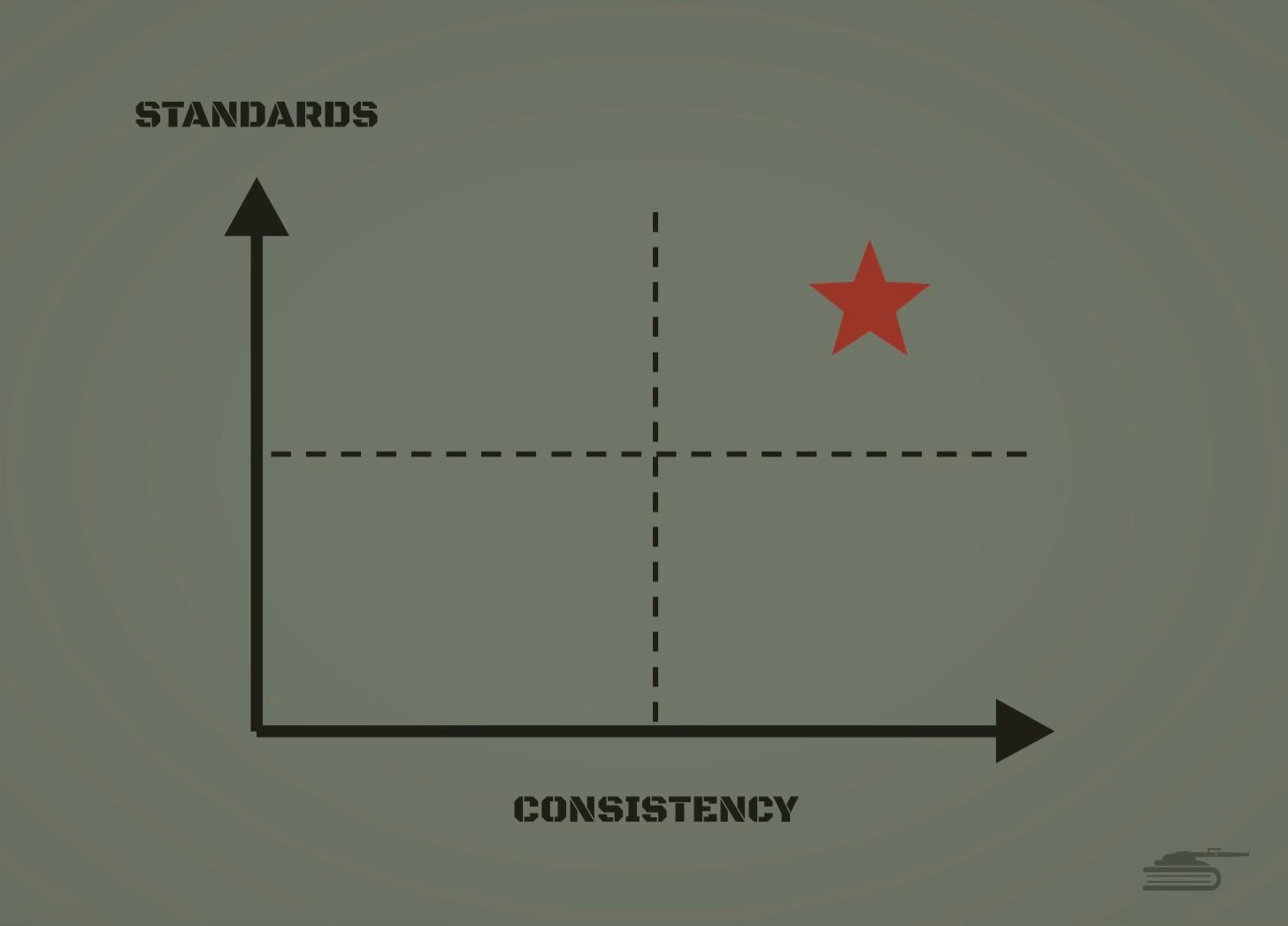
The equation of discipline: consistency on one axis, standards on the other. The star is where disciplined teams live — high standards, met every day.
The Marine Corps is known for its discipline. The reason: our leaders set high standards and consistently hold us to them. There are very few exceptions to our basic standards, and if you show that you can’t meet the level of discipline the organization requires, you will be removed. It’s not personal; it’s just business. Our currency is discipline, and everyone has to pay up.
BUSINESS
A disciplined team sets a standard and meets that standard consistently. If you want more discipline, set a higher standard and get more consistency.
Setting standards
You cannot have discipline without an established standard. A standard can be very simple: “This team publishes a report every day.” “For this shift, you show up at the exact time.” “Before any major strategic decision, we discuss it with this team.”
Once the standard is set, the expectation to meet it must be clearly communicated. Communicating the expectation stops anyone from saying they didn’t know, and it gives people the opportunity to ask clarifying questions and to raise risks to their ability to meet it. If the standard has been defined and the expectation communicated, leaders and teammates alike should feel comfortable holding everyone to it.
If a team deeply believes that maintaining the standard is fair and supports the team’s success, the team will start to self-regulate. When the entire team — not just the leadership — holds everyone to the standard, discipline is perpetually maintained.
The key is that the team deeply believes in the standards. Ideally, everyone contributes to forming them, which lets each team member suggest tweaks based on their own experience. The more collaborative the setting of the standards, the higher the belief in them.
Sometimes leadership has to establish a standard with little input from the team, or a new team member arrives after the standard is set. In those cases, the leadership and the more experienced team members should thoroughly explain why the standard matters. If the reason behind a standard is understood, belief in it can be maintained.
The intent is that everyone believes in the purpose of the standards and understands them thoroughly.
Driving consistency
Leadership supervision is the most effective way to drive consistency. If the team knows a leader will consistently inspect whether the standard is being met, they are far more likely to maintain it. That takes moral courage — the willingness to correct people when the standard isn’t met, and the willingness to support the people who are struggling to meet it. A good team works to bring everyone into standard, because they believe it helps the team succeed.
The inspected standard is the maintained standard. Supervision isn’t distrust — it’s the leader’s share of the discipline.
A more advanced way to drive consistency is a visual tracking system. The output is a manual or automated metric that drives consistency and accountability across the team. It can be as simple as everyone self-reporting on a whiteboard whether they met the standard that day, or as advanced as a dashboard producing up-to-the-minute data. The book The 4 Disciplines of Execution explains visual tracking systems very well.
A tracking system shows you who exceeds the standard and who struggles to meet it. People who consistently exceed the standard should be praised in public. People who don’t meet it should be supported in private. And if someone cannot meet the standard even with the team’s full support, it quickly becomes clear they are not a good fit. The team needs to succeed and fail together.
If a team is consistently meeting its standards, the team’s overall goals should be getting met — and that is another metric to track. When goals are visibly being met, belief in the standards grows stronger.
Conclusion
If you lead a team and want it to be more disciplined, ask yourself:
Does the team have standards for its work?
Is the expectation to meet those standards well understood by everyone?
Is the consistency of meeting the standards being tracked or supervised?
Those questions identify the gaps in the equation of discipline. Once you know the gap, fill it: set the standard, explain it clearly, and hold your team to it.
References
McChesney, Chris; Covey, Sean; and Huling, Jim. The 4 Disciplines of Execution. Link