


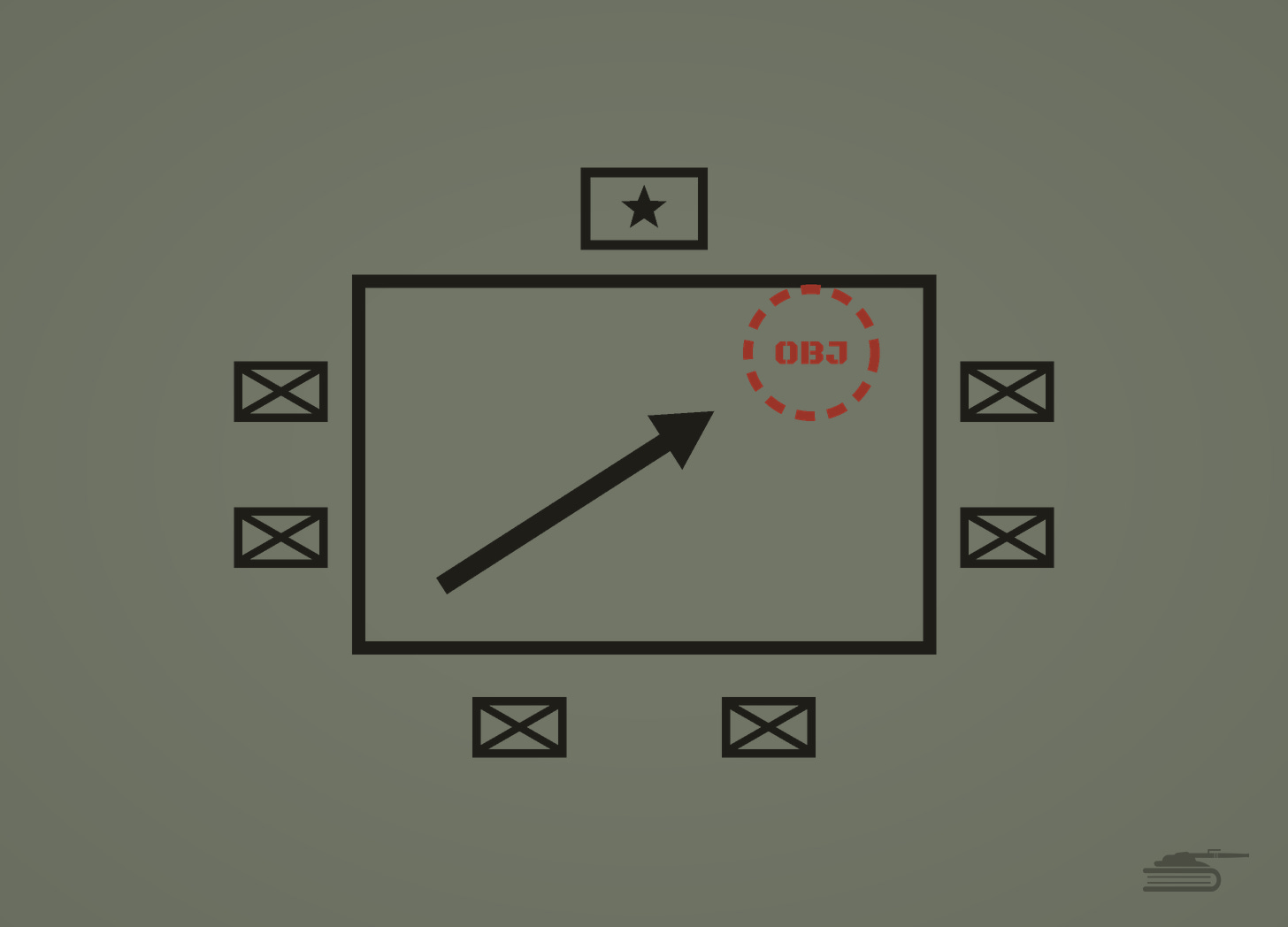
A ROC walk: every key leader gathered around the terrain model, walking their piece of the plan to the objective in front of everyone else.
Summary
Your entire organization understanding the plan in detail is the key to executing it.
The best way to teach the plan and confirm understanding is to have each key leader brief their part of it back to you, in front of the other key leaders.
Correct them and rehearse until every leader can walk the whole plan without a major error.
WAR
In battle, the more thoroughly a team understands the leader’s plan, the better its chance of victory. Understanding of the plan directly drives the speed and quality of every subordinate leader’s decisions.
After enough battles and training exercises, the pattern became impossible to miss: units that understood the plan won, and units that didn’t, didn’t. The process the military built to raise understanding of the plan is the Rehearsal of Concept walk — the ROC walk.
An Australian Army training note defines it well:
A Rehearsal of Concept (ROC) drill is a dry walk-through of a plan between a commander and their subordinates ensuring a shared understanding of the plan. It is not a repeat of the wargame. It allows a final confirmation of particularly complicated portions of the plan and may result in amendments to control measures.
In plain terms: a ROC walk is having every key leader on your team explain, out loud, how they are going to execute your plan. It lets you correct them until they understand the plan thoroughly, and it gives them an immediate channel to feed changes back into the plan.
A simple example, tasking a Marine squad with an attack:
“Sergeant Smith, your squad will attack Hill 22 after First Squad consolidates on Hill 33 and you have good indirect fire suppression on Hill 22. Use green smoke to indicate that all enemy on Hill 22 are destroyed.”
Sergeant Smith goes off and makes his plan. After a set amount of time he comes back and briefs the plan to you, so you can confirm he understood it.
At the scale of one squad, that looks more like micromanagement than coordination. Now scale it up. Imagine three maneuver platoons with weapons attachments, engineers, aircraft, and tanks, all of which have to synchronize during one attack, probably over 200 people. Nobody calls the back brief micromanagement anymore.
The first step is communicating the plan well in the first place. The Marine Corps does this with a thorough planning process — BAMCIS, METT-TC, the Marine Corps Planning Process, if you want the acronyms — and a common briefing format, the five-paragraph order. Those make sure the plan is complete and that it is communicated effectively the first time.
The problem is that many, probably most, of the people listening missed some important piece of it. Worse, they won’t realize they missed it until execution — so they won’t ask you a single question.
The question becomes: how does a leader confirm that everyone actually understands the plan?
They run a ROC walk — a method of having each subordinate leader back brief the plan to you and to the whole group. The high-level process looks like this:
The commander briefs the plan to the team.
The team breaks for a set amount of time, so each subordinate leader can review the overall plan and build their own plan for the portion they own.
The team reassembles, and each subordinate briefs their part of the plan to everyone. The commander corrects and adjusts the plan on the spot, and the group works through contingencies and each leader’s response to them.
The outcome: every leader walks out with high confidence that everyone understands the plan.
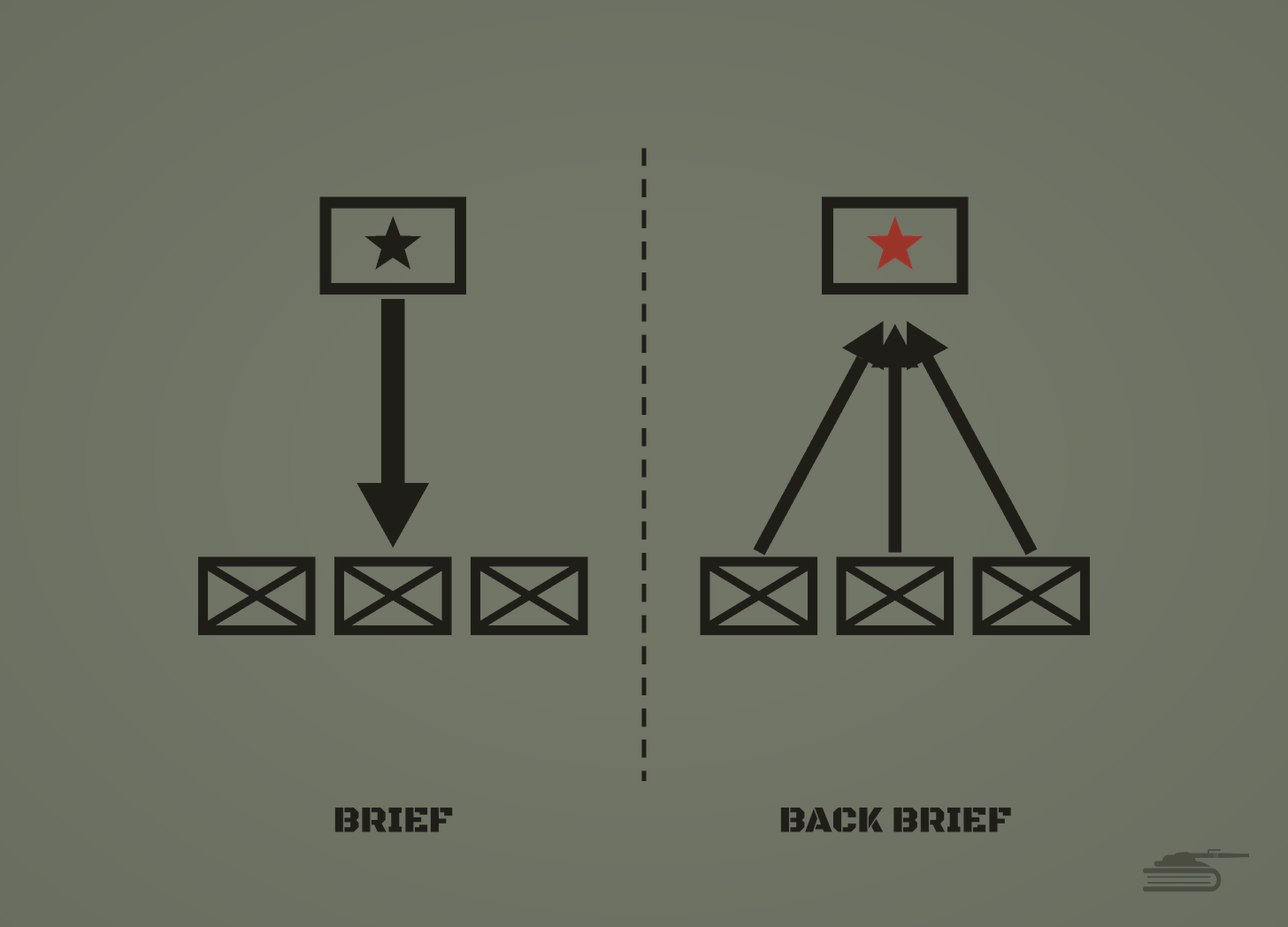
Left: the brief is one broadcast, and most of the audience misses something. Right: the back brief is every leader explaining the plan up to the commander — which is where the misses surface and get corrected.
The best version I have seen makes it physical. Each leader has to move something on a terrain model or a map and talk through all of the conditions surrounding it. When their phase of the plan is complete, they hand off to the next leader, who walks their portion. This is done for the primary plan and for the most likely contingencies.
Along the way your leaders will make mistakes. You correct them on the spot and make them go back over that section until they get it right. You keep going until every leader can walk the entire plan with no mistakes — demonstrating that they understand the intent of each phase and the conditions that have to be in place to move forward.
This kind of back briefing is extremely effective. As a leader, it gives you immense confidence that your team understands every detail, and it gives them a dozen openings to show you what the plan looks like from their perspective. If you read the Connecting File post, you’ll recognize what this is: the read-back, scaled up to the whole plan.
Then the leaders who have been through a ROC walk go run one with their own teams, and the understanding starts to permeate the entire unit. If the lowest-ranking rifleman can back brief the plan, your chance of success skyrockets.
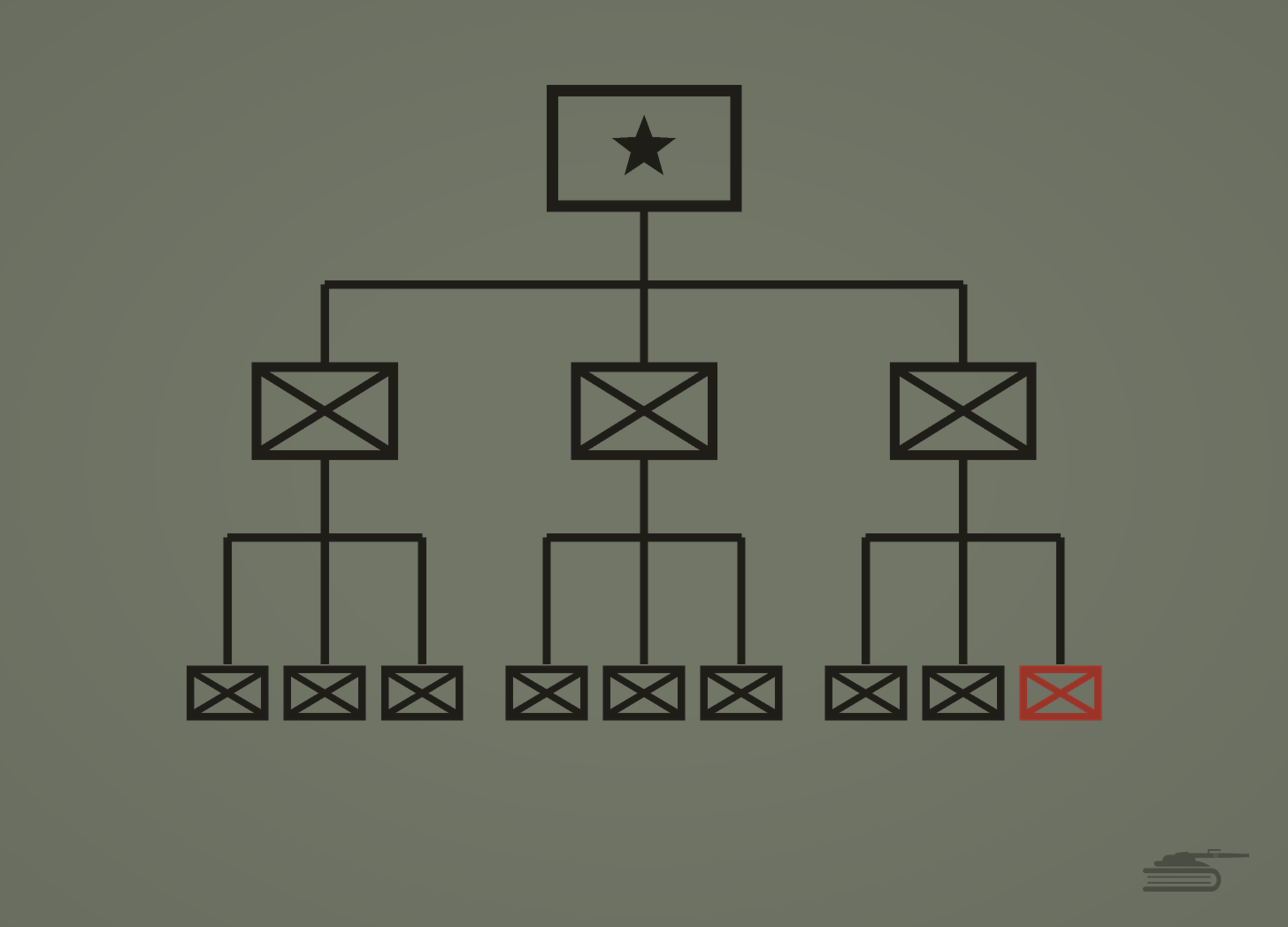
The cascade: each leader runs the walk with their own team, and the test of the whole thing is the last rifleman on the line. If he can brief the plan, the unit understands it.
Better understanding, more flexibility
My initial instinct was that the more detailed your planning, the more rigid your execution. In my experience it’s the opposite. The better your team understands the plan, the easier it is to change it. The shared context built during planning gives everyone a framework to flex from.
If your subordinate leaders deeply understand their role in fulfilling the intent and the conditions of each phase, they can make good decisions without your input.
Eisenhower put it in one line: “Plans are worthless, but planning is everything.” The plan is not the important part. The understanding of the plan is. The more everyone understands the purpose and reasoning behind each decision inside the plan, the better their decisions will be when the plan starts to change — and it will.
BUSINESS
The ROC walk translates directly to the civilian world — with one prerequisite that is, honestly, where most companies fall down.
First, the leader needs a plan. This is a common gap: plenty of goals and objectives get set, but a detailed plan to accomplish them — with priorities and deconfliction across the whole organization — doesn’t exist. (The real work a leader does is deconflicting and supporting their teams at the friction points. That’s a post of its own.)
Assuming you have a plan, the steps are the same ones the Marines use:
Brief the plan to your team to get buy-in and make adjustments.
Give them adequate time to process it and plan their own portion.
Bring everyone back, and have each key leader present how they are going to execute their part — with every other key leader in the room to ask questions and clarify.
The intent of that session is for each key leader to demonstrate three things: a deep understanding of the whole plan, a detailed plan for their own portion, and an eye for where deconfliction between departments is needed.
What it looks like in practice: say the plan is a product launch. Marketing, engineering, operations, and sales each own a phase on one shared timeline. The marketing lead walks the launch campaign against the dates the engineering lead just committed to — and the room discovers the campaign goes live a week before the feature does. The ops lead walks fulfillment and realizes nobody has told sales what the stock constraint is. None of those are mistakes anyone would have found in a status meeting. All of them surface in twenty minutes when the leads have to walk the plan in front of each other, in sequence, phase by phase.
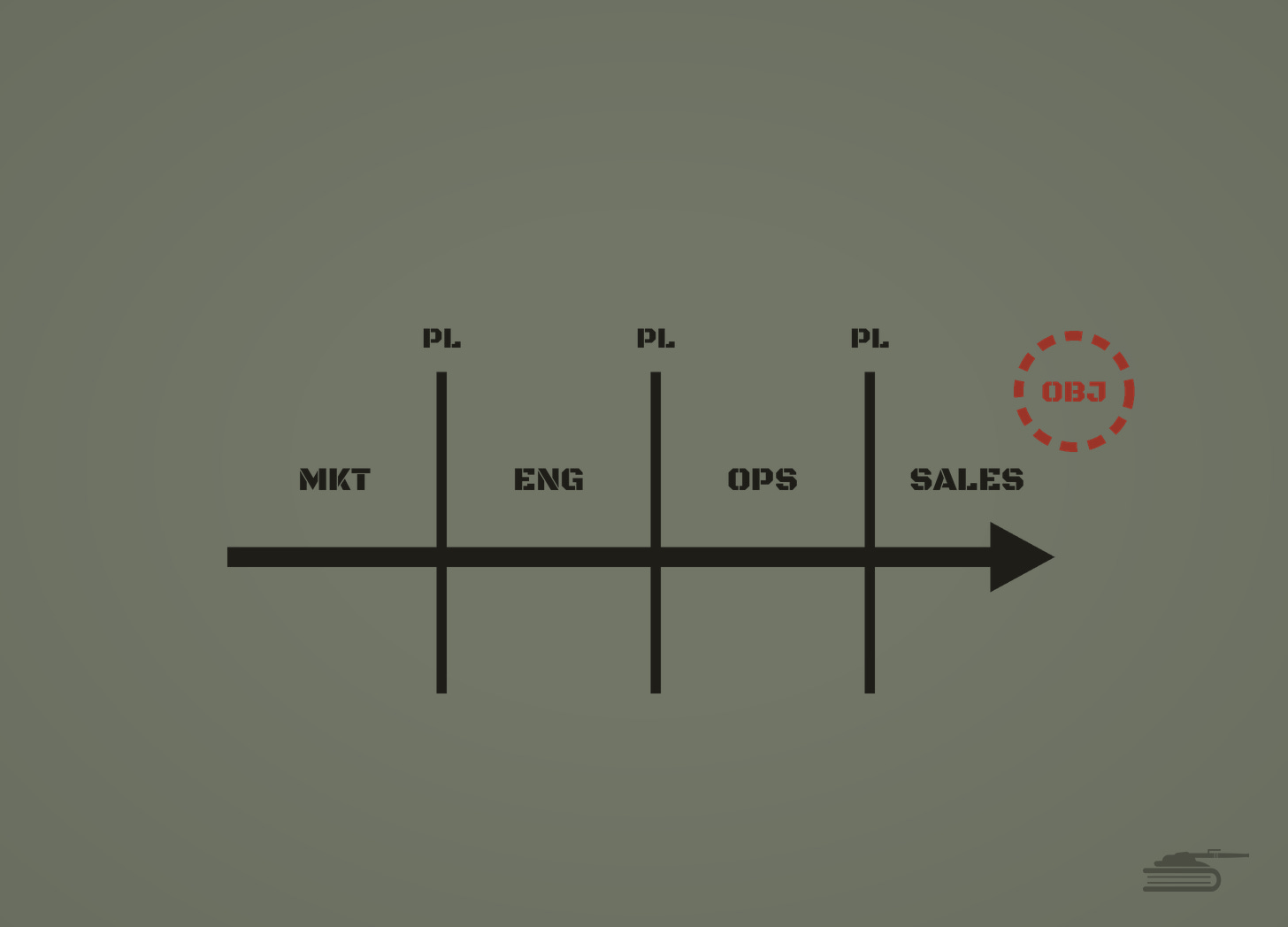
A business ROC walk: one timeline, one objective, each lead walking their phase in order. The seams between departments are where the plan breaks — and where the walk catches it.
Correct on the spot, exactly as in the field. Where a lead’s understanding is off, fix it in the room; where the plan is wrong, change the plan. Then send your leads to run the same walk with their own teams. The goal is the same as the rifleman test: can the person actually doing the work explain how their piece fits the whole?
Every key leader should come out of a ROC walk confident that everyone is working toward the same goals, and clear on the priorities that set the conditions for each phase of the plan.
Key takeaways
A briefed plan is not an understood plan. Most of your team missed something, and they won’t know it until execution.
Confirm understanding by having each key leader walk their part of the plan back to you, in front of the others, until nobody makes a major error.
Understanding is what makes a plan flexible: a team that deeply understands the plan can change it; a team that merely received it can’t.
References
Birch, Anthony (LTCOL), and Huw Kirby (MAJ). “ROC Drills — Observations from Combat Training Centre.” Australian Army, The Cove. Link