


Summary
The principle of massing is to concentrate as much of your resources as possible at a decisive point in order to gain an overall advantage over your competition.
This means limiting resources allocated to other areas that could also use them.
If you had to win in one area, which one would give you the biggest advantage over your competition? That is where you should mass as much as you can.
The video version of this article:
WAR
MCWP 3-10, MAGTF Ground Operations defines massing as:
The purpose of mass is to concentrate the effects of combat power at the most advantageous place and time to produce decisive results. In order to achieve mass, appropriate joint force capabilities are integrated and synchronized where they may have a decisive effect quickly. Mass must be sustained to have the desired effect.
In simple terms, massing means putting everything you have into the advantage that matters most at that moment.
In war, massing generally refers to concentrating artillery, mortars, and airpower in a single location to break through an enemy infantry unit. Once that point is breached, it can be exploited.
Consider the following example.
Imagine you are an infantry battalion commander with three infantry companies. All three are heavily engaged with the enemy. Each is in trouble, and each is requesting artillery support.
You have a choice.
You can spread your artillery across all three companies so that each receives a small amount of support, or you can concentrate your fires on one company and help them decisively win their fight.
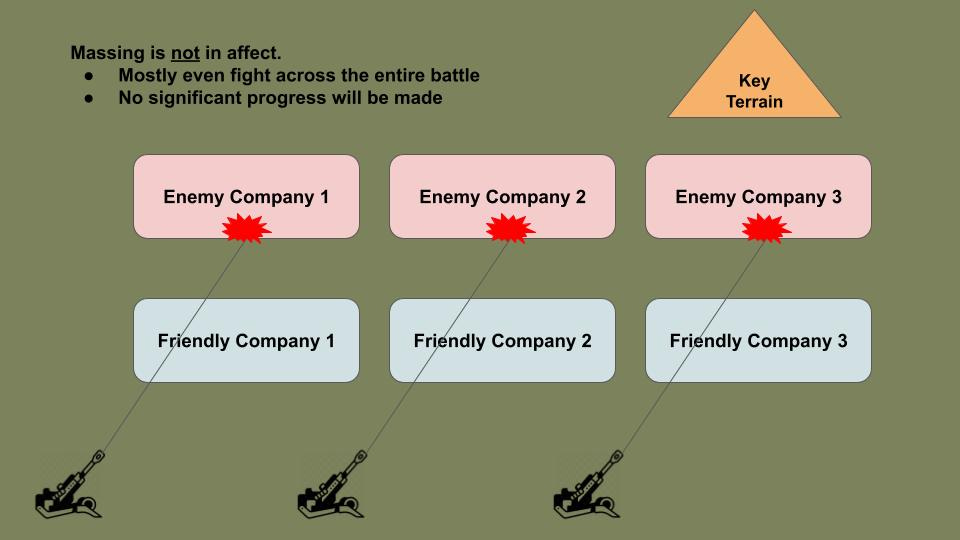
The principle of massing makes the decision clear. The company whose breakthrough would give the entire battalion the greatest advantage should receive as much artillery support as necessary to win. The other companies will have to accept little or no support, depending on how much the priority company requires.
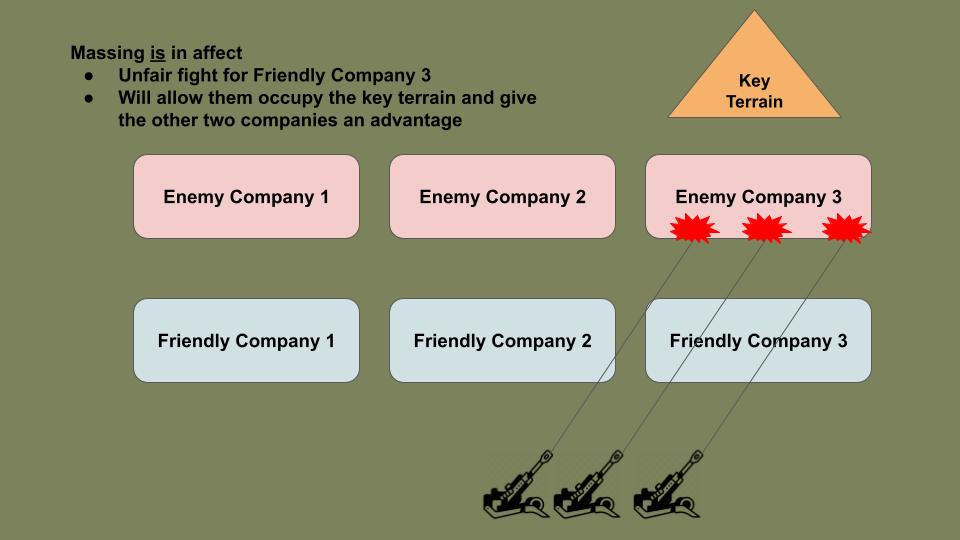
The priority company is usually the one closest to key terrain or a critical objective. If artillery support enables that company to seize it, the balance of the entire fight can shift, giving the battalion a chance to win.
This is a painful choice.
The analysis will not be easy.
What if the commander chooses the wrong company and massing fires fails to achieve a breakthrough, wasting the effort?
What if the fires are massed too heavily and the other companies are overrun, creating a serious disadvantage elsewhere?
Massing will always be a difficult decision that requires boldness and courage. The commander is deliberately diverting resources away from units that may suffer or die without support. However, the principle dictates that more people will die if the priority effort fails.
It is rarely an absolute choice. Often, there is enough artillery to give one company decisive support while still providing limited assistance to others. A leader’s job is to maximize the effectiveness of available resources.
BUSINESS
The principle of massing applies directly to business.
If you are a business leader, ask yourself:
If we had to win in one area, which one would give us the biggest advantage over our competition?
That answer is where you should mass as much money and talent as possible.
Prioritizing and allocating scarce resources is difficult. Every team has a legitimate reason for needing more people and more funding. However, leadership requires making hard choices.
As a leader, you must clearly communicate which team is the highest priority and mass resources there. Once that team is appropriately resourced, you can begin diverting resources to other parts of the business.

I define appropriately resourced as the point at which adding more people or money produces diminishing returns, or when you are confident the team will succeed.
All non-priority teams must operate lean. This expectation must be communicated clearly. They need to understand why they are not receiving the funding or personnel they are requesting.
When people know they are not getting additional help, they tend to get scrappy and resourceful. If they believe help might be coming, they often slow down and wait for it. Make sure they understand they must make do with what they have while the priority team works to break through.
Massing on the correct opportunity is the key to success. Leaders must make the best decision they can with the information available at the time. Better analysis and better inputs lead to better decisions.
Key Takeaways
Give your priority team everything they need to succeed.
Clearly inform non-priority teams that they will not receive additional resources and must operate lean.
Reference
Headquarters, United States Marine Corps. (2018, April). MCWP 3-10: MAGTF Ground Operations.
Simple and confronting. It’s hard to not look at the ways we are engaging with our own lives and business’ through this model/lens.